World Focus on Samso, Denmark
http://worldfocus.org/blog/2009/12/07/island-in-denmark-produces-more-energy-than-it-consumes/8768/
and
http://www.guardian.co.uk/environment/2009/dec/07/us-climate-carbon-emissions-danger
Monday, December 7, 2009

More for the last week of class
Unprecedented editorial in my paper today:
http://www.guardian.co.uk/commentisfree/2009/dec/06/copenhagen-editorial
http://www.guardian.co.uk/commentisfree/2009/dec/06/copenhagen-editorial
Sunday, December 6, 2009
Articles for last week of class
Jared Diamond on business sustainability
http://www.nytimes.com/2009/12/06/opinion/06diamond.html?pagewanted=1&hp
NYT on the administration and the Afghan surge
http://www.nytimes.com/2009/12/06/world/asia/06reconstruct.html?hp
http://www.nytimes.com/2009/12/06/opinion/06diamond.html?pagewanted=1&hp
NYT on the administration and the Afghan surge
http://www.nytimes.com/2009/12/06/world/asia/06reconstruct.html?hp
Saturday, December 5, 2009
Best activity pictures of the semester
What did you do with your semester?
This is a cross section of what my students were doing. These are in reverse chronological order.
What these pictures have in common is that they are all "action shots" and unposed, although some of the subjects knew they were being photographed at the time and struck funny or silly poses.
You can click on an image to enlarge. Narrow or widen your browser window to make captions line up with photos.

"Dead-eye Dierdre," ready to shoot.

Snorri, the Womerlippi Farm rental ram, ramming it up for the camera.

Me, working on the decibel-linked anemometer for the Fox Islands Wind project

Ervin, one of our local Amishmen, climbs his turbine. He needs to get a safety harness.

Ervin concentrates on some welding

Kaylee and Heather board some boarding boards

SAR team students on a mock evacuation

Teaching the horizontal lower using the tandem system.

My favorite classroom setting

Getting ready for the lower

Learning to rappel

Spreading "mud" for the barn foundation: a dance choreography

Tough customers: Who you lookin' at?
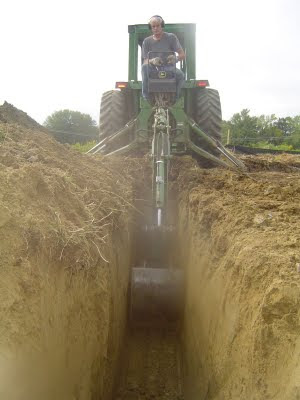
A trenchant Unity character.

Cody on the tower at our Charleston wind assessment site

Et moi

Worm's eye view of a Freedom turbine

An Aaron in the wet
This is a cross section of what my students were doing. These are in reverse chronological order.
What these pictures have in common is that they are all "action shots" and unposed, although some of the subjects knew they were being photographed at the time and struck funny or silly poses.
You can click on an image to enlarge. Narrow or widen your browser window to make captions line up with photos.

"Dead-eye Dierdre," ready to shoot.

Snorri, the Womerlippi Farm rental ram, ramming it up for the camera.

Me, working on the decibel-linked anemometer for the Fox Islands Wind project

Ervin, one of our local Amishmen, climbs his turbine. He needs to get a safety harness.

Ervin concentrates on some welding

Kaylee and Heather board some boarding boards

SAR team students on a mock evacuation

Teaching the horizontal lower using the tandem system.

My favorite classroom setting

Getting ready for the lower

Learning to rappel

Spreading "mud" for the barn foundation: a dance choreography

Tough customers: Who you lookin' at?

A trenchant Unity character.

Cody on the tower at our Charleston wind assessment site

Et moi

Worm's eye view of a Freedom turbine

An Aaron in the wet
Friday, December 4, 2009
Boston Globe article on Unity Amish impacts this blog

The main purpose of this blog is to communicate with students and friends of the college, particularly to provide a place where our extended Unity College family of sustainability-minded folks can catch up. A secondary purpose is to create an ongoing record of materials used for teaching in my various classes, a kind of library reserve. It's also helpful to have a place to publish student work and have them get an audience.
A final use is just as an outlet for my frustrated journalistic and publishing "talents." I'm really too busy teaching, building, and working on community renewables and energy efficiency to have much time for writing, let alone serious research (although I would love more time to do both), but having a blog helps me stay in touch with developments in my fields.
So it was only of side interest for me that my Amish friend Ervin, who makes his own wind turbines, was the subject of a Boston Globe article this last Sunday, and that the article was front page news. I took most of a day off from barn-building to help host the reporter, Sarah Schweitzer, although that turned out to be largely unnecessary since she proved quite capable of finding her own way around. It was fun and educational to hear Ervin describe the family and Unity Amish church meeting's beliefs, their ordnung, and their outlook on the world. I learned a few things I didn't know. I was pleased for Ervin, although a little concerned too about the potential result.
But what was almost as interesting to me was the increase in interest in the college and our sustainability programs as a result. The graph is the results from my blog-tracking service for that weekend, and see the spike in hits on Monday. Four times as many as normal.
I hope the folks that visited for the first time went away having found something interesting.
Population offsets
Another pre-Copenhagen headline to make you think:
Rich nations to offset emissions with birth control
Radical plan to cut CO2 argues that paying for family planning is developing world is the best bet
Rich nations to offset emissions with birth control
Radical plan to cut CO2 argues that paying for family planning is developing world is the best bet
Thursday, December 3, 2009
Jim Hansen pre-emptively bombs Copenhagen
Copenhagen climate conference
Copenhagen climate change talks must fail, says top scientist
Exclusive: World's leading climate change expert says summit talks so flawed that deal would be a disaster
http://www.guardian.co.uk/environment/2009/dec/02/copenhagen-climate-change-james-hansen
I might have expected this, although I wouldn't have guessed it would make the front page.
I'm not sure Jim is right about the politics.
I am sure he's right about the science.
Including trading. Although I helped pioneer some fairly creative uses of offsets in Maine (bundling Maine Housing energy efficiency improvements to gain offset income), that was perhaps hypocritical on my part because I've never really believed a trading regime would work that well in large scale. The main reason I wanted the offsets was because they were required for us by the ACUPCC, and was durned if I was going to pay for traffic lights in Portland Oregon, which was what another Maine college chose to do.
In this case, though, I think we need to get our first international climate agreement behind us. Climate treaty policy is going to be for the first decades of the 21st century what the General Agreement on Tarrifs and Trades (GATT) was for the last of the 20th century, all high level negotiations that set the terms of the balance of trading power throughout the world, and like the many rounds of the GATT, we need to get in the habit of having one.
There's another article that's interesting, too, an editorial by Sachs, headlined "Time to let the experts lead."
I liked his paragraph summary of what serious climate problem solving looks like:
"Here, then, is a proposal for the post-Copenhagen attempt to square up national and global policies so they add up to something more than more years of empty promises. Let's start by recognising that most of the human-made crisis emerges from a few pivotal human activities: how and what we grow to eat; how we mobilise and distribute energy; how we transport ourselves and our freight; and how we build our buildings and lay out our cities. Each related sector requires its own intensive strategy – to identify the kind of research and development activities, public infrastructure investments and public policy to accompany a positive price on carbon emissions, through permits or taxes. Countries would have a lot to share – for instance in new technological options – and a lot that would distinguish them, according to geography, resource base, development level, and more."
And
"...Copenhagen should be the end of negotiation by politicians with technical issues kept in the shadows or ignored. Let's get scientists, engineers and ordinary citizens involved in a true discussion about our common future, and especially the tradeoffs, costs and choices. Together we can prove that our world is still capable of reaching long-range agreements when our children's lives and wellbeing hang in the balance."
Copenhagen climate change talks must fail, says top scientist
Exclusive: World's leading climate change expert says summit talks so flawed that deal would be a disaster
http://www.guardian.co.uk/environment/2009/dec/02/copenhagen-climate-change-james-hansen
I might have expected this, although I wouldn't have guessed it would make the front page.
I'm not sure Jim is right about the politics.
I am sure he's right about the science.
Including trading. Although I helped pioneer some fairly creative uses of offsets in Maine (bundling Maine Housing energy efficiency improvements to gain offset income), that was perhaps hypocritical on my part because I've never really believed a trading regime would work that well in large scale. The main reason I wanted the offsets was because they were required for us by the ACUPCC, and was durned if I was going to pay for traffic lights in Portland Oregon, which was what another Maine college chose to do.
In this case, though, I think we need to get our first international climate agreement behind us. Climate treaty policy is going to be for the first decades of the 21st century what the General Agreement on Tarrifs and Trades (GATT) was for the last of the 20th century, all high level negotiations that set the terms of the balance of trading power throughout the world, and like the many rounds of the GATT, we need to get in the habit of having one.
There's another article that's interesting, too, an editorial by Sachs, headlined "Time to let the experts lead."
I liked his paragraph summary of what serious climate problem solving looks like:
"Here, then, is a proposal for the post-Copenhagen attempt to square up national and global policies so they add up to something more than more years of empty promises. Let's start by recognising that most of the human-made crisis emerges from a few pivotal human activities: how and what we grow to eat; how we mobilise and distribute energy; how we transport ourselves and our freight; and how we build our buildings and lay out our cities. Each related sector requires its own intensive strategy – to identify the kind of research and development activities, public infrastructure investments and public policy to accompany a positive price on carbon emissions, through permits or taxes. Countries would have a lot to share – for instance in new technological options – and a lot that would distinguish them, according to geography, resource base, development level, and more."
And
"...Copenhagen should be the end of negotiation by politicians with technical issues kept in the shadows or ignored. Let's get scientists, engineers and ordinary citizens involved in a true discussion about our common future, and especially the tradeoffs, costs and choices. Together we can prove that our world is still capable of reaching long-range agreements when our children's lives and wellbeing hang in the balance."
Subscribe to:
Posts (Atom)