Sunday, August 15, 2010
Article and video on wind vs. coal in WV
The article is better than the video. You definitely need to read it to get the full picture.
http://www.nytimes.com/2010/08/15/business/energy-environment/15coal.html?pagewanted=1&hp

David Roberts
David Roberts of Grist has published a cogently argued piece, reprinted in the Guardian, on why the US environmental movement is not and never will be capable of dealing with climate change. Roberts does a very good job of summarizing the problem and reasoning to the ultimate solution.
The whole piece is here.
Here's the conclusion:
"What needs to happen is for concern over earth's biophysical limitations to transcend the environmental movement -- and movement politics, as handed down from the '60s, generally. It needs to take its place alongside the economy and national security as a priority concern of American elites across ideological and organizational lines. It needs to become a shared concern of every American citizen regardless of ideological orientation or level of political engagement. That is the only way we can ever hope to bring about the urgent necessary changes."
He's right. And he's encapsulated the whole thing in a nutshell. Nicely done.
The problem is, and I've mentioned this before several times and only quite recently here, this kind of 180 degree change in the overall pattern of widely held mental models in the US happens very rarely and only in response to very serious events. And I keep being brought back to World War Two, although I must sound like a stuck record.
Pearl Harbor was enough to get the US into World War Two, but Hurricane Katrina wasn't enough to reorganize American ideas about climate change.
And if the more or less total destruction of a US city wasn't enough, you have to ask yourself what is? Certainly not the Pakistani floods, nor the Russian fires, nor even this record-breaking long hot summer in the US and Canada.
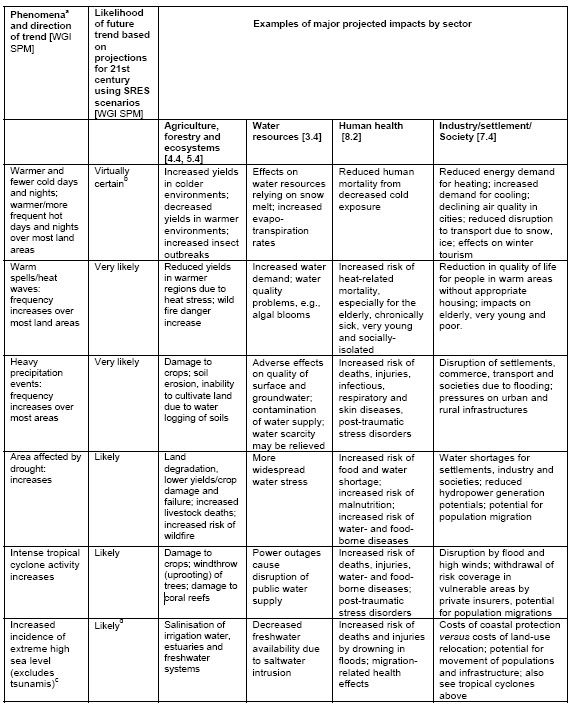
Never mind that all this was predicted with quite good accuracy in the 2001 and 2007 IPPC Reports. (A reproduction of the table that summarized the prediction is here.)
When the Japanese navy attacked Pearl Harbor on December 7th, 1941, despite the fact that the war had been going on for over two years, and despite the fact that reports of massacres of Jews and other non-Aryans had been leaking out of Europe since mid-1940, millions of Americans were still walking around with a mental model of the world situation in their heads that somehow told them that the Japanese would never attack America, and that the European war would not affect them and could safely be left alone.
This mental model wasn't reorganized until the obvious destruction of the Pacific Fleet on December 7th.
Today, the situation is similar. We should be smart enough to admit that millions of Americans are walking around with a mental model in their head that somehow says that climate change is most likely not happening, or if it is, it's not going to be too terribly bad. A smaller number, those most ideological, are walking around with a slightly more elaborate mental model that tells them that climate awareness and advocacy is a political choice, one that left-of-center people pick, when they could reasonably make other choices.
In other words, millions of rather ordinary and only moderately conservative Americans believe that left-of-center people decide to be aware of climate change and support climate policy in the same way that we might decide that we're in favor of gay marriage or publicly-run health care.
It's a choice, not a necessity, and one only chosen by leftists. That's what they think.
And to some extent they are right. There's been a lot of bandwagon-jumping, and the left has embraced climate change and used it as a Trojan Horse for other ideas and policies, including many that are just plain stupid or frivolous. Read some people's material on what to do about climate change and you'd think we will all be living in 1970s type communes, eating nothing but radishes and walking everywhere, within a few short years.
But that doesn't mean to say that it isn't still the biggest issue facing humanity, nor does it mean to say that ordinary Americans, and even these ordinary, moderate American conservatives, can safely ignore it.
Contrast the way that Americans felt about World War 2 in, say, 1941, with the way that Europeans felt about it at the same time, and you might begin to get an idea how most climate scientists and serious energy thinkers feel about this. If you were my grandfather, say, a very ordinary Englishman, you'd already been in the Army for two years, although you were 41 years old and had a wife and kid at home in Sheffield. You'd already lived through the Battle of Britain and the Blitz. Your home neighborhood had been bombed. You actually thought you were lucky (at your rather advanced age) not to be sent to France (again) in October 1940 and have to suffer through Dunkirk.
Instead you'd been assigned to heavy rescue in London.
Lucky.
How much more real was World War Two for you, compared to one of isolationist Senator Burton Wheeler's Montana constituents? Obviously, by 1940, it was no longer possible for my grandfather to hold the mental model he had previously held, around the time of the Munich fiasco, which was that war was a terrible thing (he'd been in the trenches in the first war) and Britain should do everything it could do to stay out of another one. That mental model, held by millions of ordinary Britons, had all but evaporated by June 1940.
But it was still possible for Burton K. Wheeler's Montanan to hold his particular view, right up to December 6th, 1941. And so Americans, and their Congress, did very little to think about or prepare for the war.
The problem is, by the time you get to December 7th, if all you do is wait for people to change their minds, you're in a lot of trouble. Luckily, we didn't wait. A smaller number of people took action. We had FDR, who had begun to rearm even before September 3rd, 1939. We had the designs for the machines that would win the war, the Liberty ship, the Sherman tank, the jeep and the B17, completed, and some of the latter were already in service and even destroyed at Pearl Harbor. Factories had already shifted to war production to meet first British and then, after July 22nd 1941, Soviet demand.
Congress did pass Lend-Lease and we did have the destroyers-for-bases deal, as well as the convoy system. We did enough to stave off disaster.
The most important thing that happened was that Britain did not lose the war or surrender before December 7th. That meant that the war would continue to be in the news, that Edward R. Murrow would report from London during the Blitz, that Joe Kennedy would come to be seen as a fool and poltroon for his defeatist reports, and that Hitler would always have that giant aircraft carrier in the North Sea called the British Isles in his rear when he turned his sights east to all that Soviet Lebensraum.
When ordinary kinds of conservative Americans finally reorganize their mental models about climate change, we had better have done quite a lot of this kind of preparatory stuff. And there's lots that can be done without having to wait for a climate bill. Energy efficiency and renewable energy projects that can pay their own way and compete even at today's oil prices can be begun tomorrow, if we choose. We can certainly make sure that we have cadres of well-trained people to do the work, to be the trainers that train the trainers that eventually train the people that will really reorganize American industry and agriculture. We can think about how to scale up, just how we might organize to completely insulate and weatherize our existing housing stock, or just how we might organize to make enough thin-film solar for every rooftop.
But the most important thing we can do is not surrender, to not go away quietly. Because there will come a time when the evidence is so compelling, when the scientific explanation of what is happening is the only one that fits, and millions of ordinary people are forced to admit what is already obvious to us, that we have to reduce carbon emissions very, very quickly, and all these ideas and processes and techniques get put into action on a massive scale.
And we would be smart, too, if in preparation for that day, we would lay off our bandwagon-jumping, and come up with a mental model of climate response that ordinary kinds of conservative Americans can accept. One that doesn't seem to want to abolish capitalism, for instance. One that is rational, and scientific, and that doesn't use climate change as a Trojan Horse for hemp or transcendental meditation or eating radishes in a commune or some other happy horsepoop.
And then we wait. Unfortunately.
The whole piece is here.
Here's the conclusion:
"What needs to happen is for concern over earth's biophysical limitations to transcend the environmental movement -- and movement politics, as handed down from the '60s, generally. It needs to take its place alongside the economy and national security as a priority concern of American elites across ideological and organizational lines. It needs to become a shared concern of every American citizen regardless of ideological orientation or level of political engagement. That is the only way we can ever hope to bring about the urgent necessary changes."
He's right. And he's encapsulated the whole thing in a nutshell. Nicely done.
The problem is, and I've mentioned this before several times and only quite recently here, this kind of 180 degree change in the overall pattern of widely held mental models in the US happens very rarely and only in response to very serious events. And I keep being brought back to World War Two, although I must sound like a stuck record.
Pearl Harbor was enough to get the US into World War Two, but Hurricane Katrina wasn't enough to reorganize American ideas about climate change.
And if the more or less total destruction of a US city wasn't enough, you have to ask yourself what is? Certainly not the Pakistani floods, nor the Russian fires, nor even this record-breaking long hot summer in the US and Canada.
Never mind that all this was predicted with quite good accuracy in the 2001 and 2007 IPPC Reports. (A reproduction of the table that summarized the prediction is here.)
When the Japanese navy attacked Pearl Harbor on December 7th, 1941, despite the fact that the war had been going on for over two years, and despite the fact that reports of massacres of Jews and other non-Aryans had been leaking out of Europe since mid-1940, millions of Americans were still walking around with a mental model of the world situation in their heads that somehow told them that the Japanese would never attack America, and that the European war would not affect them and could safely be left alone.
This mental model wasn't reorganized until the obvious destruction of the Pacific Fleet on December 7th.
Today, the situation is similar. We should be smart enough to admit that millions of Americans are walking around with a mental model in their head that somehow says that climate change is most likely not happening, or if it is, it's not going to be too terribly bad. A smaller number, those most ideological, are walking around with a slightly more elaborate mental model that tells them that climate awareness and advocacy is a political choice, one that left-of-center people pick, when they could reasonably make other choices.
In other words, millions of rather ordinary and only moderately conservative Americans believe that left-of-center people decide to be aware of climate change and support climate policy in the same way that we might decide that we're in favor of gay marriage or publicly-run health care.
It's a choice, not a necessity, and one only chosen by leftists. That's what they think.
And to some extent they are right. There's been a lot of bandwagon-jumping, and the left has embraced climate change and used it as a Trojan Horse for other ideas and policies, including many that are just plain stupid or frivolous. Read some people's material on what to do about climate change and you'd think we will all be living in 1970s type communes, eating nothing but radishes and walking everywhere, within a few short years.
But that doesn't mean to say that it isn't still the biggest issue facing humanity, nor does it mean to say that ordinary Americans, and even these ordinary, moderate American conservatives, can safely ignore it.
Contrast the way that Americans felt about World War 2 in, say, 1941, with the way that Europeans felt about it at the same time, and you might begin to get an idea how most climate scientists and serious energy thinkers feel about this. If you were my grandfather, say, a very ordinary Englishman, you'd already been in the Army for two years, although you were 41 years old and had a wife and kid at home in Sheffield. You'd already lived through the Battle of Britain and the Blitz. Your home neighborhood had been bombed. You actually thought you were lucky (at your rather advanced age) not to be sent to France (again) in October 1940 and have to suffer through Dunkirk.
Instead you'd been assigned to heavy rescue in London.
Lucky.
How much more real was World War Two for you, compared to one of isolationist Senator Burton Wheeler's Montana constituents? Obviously, by 1940, it was no longer possible for my grandfather to hold the mental model he had previously held, around the time of the Munich fiasco, which was that war was a terrible thing (he'd been in the trenches in the first war) and Britain should do everything it could do to stay out of another one. That mental model, held by millions of ordinary Britons, had all but evaporated by June 1940.
But it was still possible for Burton K. Wheeler's Montanan to hold his particular view, right up to December 6th, 1941. And so Americans, and their Congress, did very little to think about or prepare for the war.
The problem is, by the time you get to December 7th, if all you do is wait for people to change their minds, you're in a lot of trouble. Luckily, we didn't wait. A smaller number of people took action. We had FDR, who had begun to rearm even before September 3rd, 1939. We had the designs for the machines that would win the war, the Liberty ship, the Sherman tank, the jeep and the B17, completed, and some of the latter were already in service and even destroyed at Pearl Harbor. Factories had already shifted to war production to meet first British and then, after July 22nd 1941, Soviet demand.
Congress did pass Lend-Lease and we did have the destroyers-for-bases deal, as well as the convoy system. We did enough to stave off disaster.
The most important thing that happened was that Britain did not lose the war or surrender before December 7th. That meant that the war would continue to be in the news, that Edward R. Murrow would report from London during the Blitz, that Joe Kennedy would come to be seen as a fool and poltroon for his defeatist reports, and that Hitler would always have that giant aircraft carrier in the North Sea called the British Isles in his rear when he turned his sights east to all that Soviet Lebensraum.
When ordinary kinds of conservative Americans finally reorganize their mental models about climate change, we had better have done quite a lot of this kind of preparatory stuff. And there's lots that can be done without having to wait for a climate bill. Energy efficiency and renewable energy projects that can pay their own way and compete even at today's oil prices can be begun tomorrow, if we choose. We can certainly make sure that we have cadres of well-trained people to do the work, to be the trainers that train the trainers that eventually train the people that will really reorganize American industry and agriculture. We can think about how to scale up, just how we might organize to completely insulate and weatherize our existing housing stock, or just how we might organize to make enough thin-film solar for every rooftop.
But the most important thing we can do is not surrender, to not go away quietly. Because there will come a time when the evidence is so compelling, when the scientific explanation of what is happening is the only one that fits, and millions of ordinary people are forced to admit what is already obvious to us, that we have to reduce carbon emissions very, very quickly, and all these ideas and processes and techniques get put into action on a massive scale.
And we would be smart, too, if in preparation for that day, we would lay off our bandwagon-jumping, and come up with a mental model of climate response that ordinary kinds of conservative Americans can accept. One that doesn't seem to want to abolish capitalism, for instance. One that is rational, and scientific, and that doesn't use climate change as a Trojan Horse for hemp or transcendental meditation or eating radishes in a commune or some other happy horsepoop.
And then we wait. Unfortunately.
Thursday, August 12, 2010
Penultimate field project of the summer


Our anemometry field work, having given us difficulties all summer, is finally starting to get easier.
Easy is relative, of course. It's never easy to wrestle these huge steel towers by hand up and down the state of Maine. Several times this summer I've wished for a team of mules or a tractor with some kind of super duper four wheel drive, anti-tip-over system.
With backhoe, loader, trailer and forklift permanently attached so you could use whichever you wanted any time you needed.
I don't think they make those, but if they do, that's what we'd need. That and the mules.
But what we have instead is sweat, sweat and more sweat, elbow grease, and of course, old fashioned brute force and ignorance.
Did I mention the sweat?
Anyway, sweaty scene-setting aside, there is a purpose to all this hard labor. We're trying to measure the wind for serious scale wind turbines on community-owned, state-owned, or farm business sites. About the only place we won't measure the wind is a private residence that happens not to be a real farm, ie, more than 50% of income from farming. Those we don't do. Nor do we measure wind for small scale turbines that are cheaper than anemometry equipment. That's a no-brainer.
And we don't measure for large scale commercial farms, although there's nothing to stop a Maine town government putting in a substantial, money-making, green-power making, community-owned wind farm if they so wish, such as the Fox Islands Wind Project (one of our anemometry sites earlier this year).
But if you're a farm, a town, a non-profit, or a branch of the state or federal government, we will help you out.
All the data is in the public domain, and anyone who wishes and has the knowledge to use it can contact me and get a full data set for any of the sites where public money has been used to pay for equipment or labor. Of course, this is data, so it's not very interesting unless you can crunch numbers, but we give it out for free to anyone who asks for it.
We also use the same data to read the Maine wind map very carefully, correcting intuitively where we can, and we make custom poster-size or computer-file GIS-based wind maps for anyone who asks.
At this point we have good data from enough sites in the state of Maine that we can correct the wind map for a lot of places. Not all, but enough to begin to save people time and trouble. We have enough anemometry data from our sites and those run by our partners, the University of Maine's anemometer loan program, that if you have a site in mid-central Maine, we can in some cases give you a fairly accurate wind assessment without needing to measure the wind.
Other parts of Maine, not so good. The wind map, which was made for the federal government by a private contractor in 2007, has been inaccurate enough in three or four places that we know of to encourage a project on an unsuitable site, or discourage a suitable one. We need to measure in other areas, eastern and northern Maine, and then correct the map properly, scientifically: actually correct the algorithm or wind model the map is based on.
Bit by bit, we're getting out there. This is a five or ten year project.
Yesterday's job was to finalize our biggest project of the summer, the Mercer site. This is a private farm where the owners are interested in having a farm turbine, possibly with their neighbors or community involvement. It's a mid-central Maine hilltop in a region were the wind map numbers are most inaccurate. We have sites in this region where we've measured the wind and found it to be stronger than the map number by two full wind power density classes, a Class 4 site instead of a Class 2.
Oops. Need a number check, please.
So we wanted a bit more data on that issue, and the owners wanted data to decide on their turbine, and there was federal and state money available through USDA and our partners the Efficiency Maine Trust. Maine Rural Partners, a regional agricultural advocacy organization working for farm energy efficiency and commercial viability, among other desiderata, did the outreach.
But the sweat, dear readers, was all ours. Although we had a good deal of useful and sweaty help from the farmers.
This site gave us more than the usual amount of trouble and at least one of the wind workers said that she was "done with" driving out there even though it has a nice view and there happens to be a good coffee shop along the way. We put in about fifteen or maybe twenty field days on this site, not counting the six or seven days to initially recover the equipment from the previous site, which itself was a very inaccessible mountaintop, requiring each component to be carried about half a mile down a steep trail.
The problem with Mercer was the clay soil. It had clay pan at 2-3 feet, very well drained this time of year, and hard as iron. This clay defeated no less than three different power augers, each increasingly larger and more powerful. You could chisel it away in small chunks with an iron bar, each blow requiring the full force of a pretty strong guy, but that's no way to run a railroad.
Eventually we got a back hoe and dug big holes and buried nautical-style "deadmen" anchors, using recycled wheel rims slipped over our screw-in anchor rods. There's nothing quite like a rusty sixteen-inch wheel rim under four feet of clay or glacial till, rocks and all, to give you a decent anchor. (Thanks to TA's Automotive and Salvage, a very fine and public-spritied organization, for the rims.)
Earlier this week we pull tested similar anchors at the University of Maine's Peaks Island wind site to 4,000 pounds. They would have held more, but that was already 500 pounds more than the required load, so we left off at that.
Here's wind worker Steve on the ferry to Peaks, looking positively vacational. Don't worry. By the ride back, he was good and sweaty.

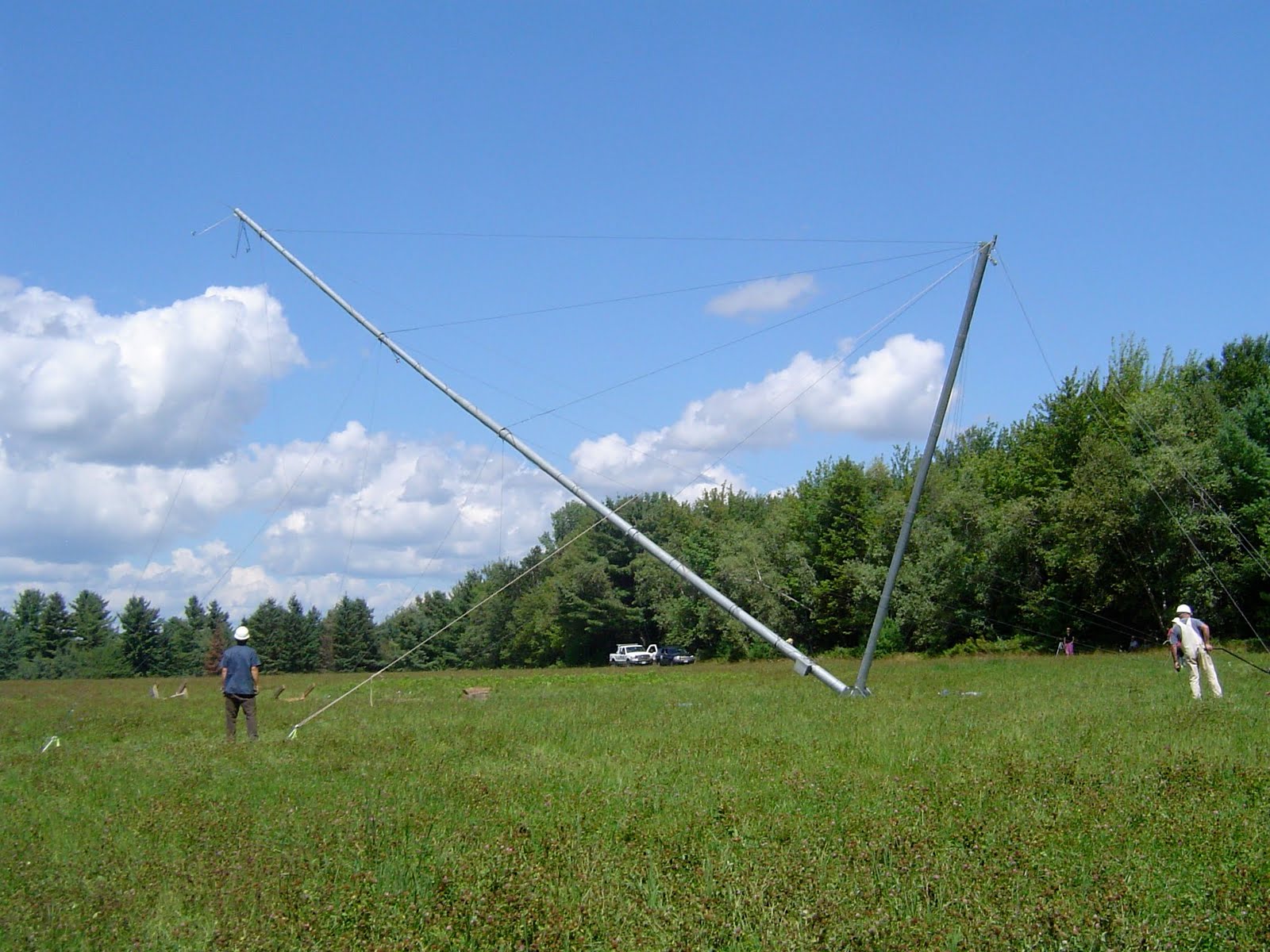
The equipment we used at Mercer was a NRG Systems 60 meter tower, which we reconfigured as a 30 meter tower for this site.
Although we started our wind program four years ago with the 60 meter equipment, the University of Maine started with 30 meter, and since we need compatible data to correct the wind map, and since 60 meters is twice as big and twice as scary, and finally, since the community partners are usually thinking of smaller turbines, we decided to use 30 meters from here on out in most of our program.
That means we get to make two 30 meters out of each 60, although we have to buy some extra base plates and guy lines to do this.
The NRG towers are called "tilt-up" towers because they hinge at the base plate, and are lifted by a winch and a "gin pole." They flex a lot and make scary noises going up and coming down. Sometimes they fall down, especially if you're inattentive to the cable tension as you raise or lower the tower. We had one fall down earlier this summer. Not for the faint-hearted.
You need to be an experienced rigger, and even then you need the NRG Systems training, to think about working with this equipment.
(The Mercer site equipment was given to our wind program by both NRG Systems and Competitive Energy Services, for which we are grateful.)
Long story short, with the deadmen and recycled and donated equipment, we were able to get an anemometer on the Mercer site for much less than the going costs. And we're collecting data that will be in the public domain. It will be accessible and free, and if you are a community organization in the mid-central area, this data will allow you to rule in, or rule out, a community turbine, for free.
When it would normally cost between $20,000 and $50,000 depending on the height of the anemometer tower. This expense, and commercial competition, means that private wind power developers generally keep their data secret.
We don't keep data secret. We collect it using public money, and so we give it out for free. We think this is a good deal, since there are very few communities that can afford this. We also feel that public wind data is more efficient and valuable than private data. This is, after all, very basic science, and although the commercial value is high, if the data is privately held, no one is looking at it in a coordinated way, and that costs everyone.
The data can also be used for proper public planning, since the turbine noise nuisance varies based on the wind. Towns and municipalities can properly plan to reduce noise, another good reason to think that public data is better than private.
We have one more day today at the Mercer site, a clean-up day. After that we have one more site to set up this summer. Then we're done with field work for a while.
Which is good, because although I enjoy the work, and although I need the exercise, I am a little tired of all that sweat. It will be nice to go out to these sites in fall and collect the data when it's a little cooler.
Wednesday, August 11, 2010
Portugal's energy independence drive

Elizabeth Rosenthal of the NYT has a good feature out which I just found although it's a day or two old.
(We're way too busy with fieldwork these remaining summer days, trying to measure Maine's winds. I'm looking forward to fall teaching because it will be a nice rest, in comparison.)
Anyway, the article is on Portugal's achievement with renewables.
Reading the comments with some interest -- well over 90 percent seemed favorable, and there were only one or two denialist-type arguments, I followed this link to the DOE's CO2 tracking center and found the Portuguese emissions record graph shown.
Of course, some of this reduction is the recession. All things being equal you'd expect an emissions drop more or less proportional to the drop in economic output.
I also notice a rise in the use of natural gas, so they're probably substituting gas for oil and coal in power production, and that's part of the reduction in CO2 emissions.
Makes sense, if you can do it. Gas is cheap right now.
Still, according to the article, forty-five percent of their electricity this year will come from in-country renewable sources.
Most of the recent additions to their renewable portfolio are from land-based wind, which they've increased by a factor of seven in the last five years.
Wonder how much wind measuring they had to do? By the time you've measured the wind properly in enough places, you don't have to measure any more. There are whole European countries where anemometric reports are no longer required for turbine placements. Models and more sophisticated maps do the work for you.
We're not there yet in Maine. Although I'm starting to think there are a few areas, such as these mid-central hills in Lincoln, Waldo, and Somerset counties, where I can guess with some accuracy what the wind speeds will be on measurement.
Tuesday, August 10, 2010
Charging capacity and climate coniptions
The upcoming release of several consumer-market EVs is interesting, even though the prices are such that the Womerlippis won't be able to afford one for years to come.
This most recent NYT article on fast-charging stations is lucid and readable, and got me more or less up-to-date on a few trends.
Despite NYT's helpful boosterism, I'm not terribly optimistic about the pace of the EV roll-out without a carbon price, though. Even after the prices have come down so that EV's are more or less the same, pound for pound of future scrap metal, as regular gas cars, there'll probably still be a consumer bias towards traditional vehicles.
And what will ultimately reduce that bias won't be the charging opportunities per se, although I expect that will help a bit. It will be the price of gas.
I'd like to see us make this transition much faster, but I doubt that will happen. The recent recession has reduced demand for oil and prices are relatively cheap and look to remain that way for a while. While the advent of both the EVs and the so-called eco-chip engines will also reduce demand. The so called peak of Peak Oil might easily be a twenty year plateau at 80-90 mbd.
So we're back to Congress and the failure to pass a climate bill. It's in some ways unfortunate that we've just had a more or less manageably sweltering summer in the US, not a ridiculously unmanageable one. We're not Pakistan, with terrible, frightening monsoon floods, or Russia with choking forest fires and excess deaths in Moscow. If we were, our senators might just be beginning to see a little climate sense right about now.
Of course, this too shall pass, although I'm not looking forward to it. It's more or less inevitable that the current and static construction of climate and energy polity comes crashing down around our heads with some new outbreak of weather emergencies in the US. Congress will then run around like a headless chicken, and maybe, just maybe, get around to passing a bill.
When that new round of climate impacts happens, as it surely must, it seems that recent progress in renewable energy and in new technology, such as these charging stations, will mean that we have some decent cards to deal.
It's just a sorrowful, crying pity that we have to wait. Again.
This most recent NYT article on fast-charging stations is lucid and readable, and got me more or less up-to-date on a few trends.
Despite NYT's helpful boosterism, I'm not terribly optimistic about the pace of the EV roll-out without a carbon price, though. Even after the prices have come down so that EV's are more or less the same, pound for pound of future scrap metal, as regular gas cars, there'll probably still be a consumer bias towards traditional vehicles.
And what will ultimately reduce that bias won't be the charging opportunities per se, although I expect that will help a bit. It will be the price of gas.
I'd like to see us make this transition much faster, but I doubt that will happen. The recent recession has reduced demand for oil and prices are relatively cheap and look to remain that way for a while. While the advent of both the EVs and the so-called eco-chip engines will also reduce demand. The so called peak of Peak Oil might easily be a twenty year plateau at 80-90 mbd.
So we're back to Congress and the failure to pass a climate bill. It's in some ways unfortunate that we've just had a more or less manageably sweltering summer in the US, not a ridiculously unmanageable one. We're not Pakistan, with terrible, frightening monsoon floods, or Russia with choking forest fires and excess deaths in Moscow. If we were, our senators might just be beginning to see a little climate sense right about now.
Of course, this too shall pass, although I'm not looking forward to it. It's more or less inevitable that the current and static construction of climate and energy polity comes crashing down around our heads with some new outbreak of weather emergencies in the US. Congress will then run around like a headless chicken, and maybe, just maybe, get around to passing a bill.
When that new round of climate impacts happens, as it surely must, it seems that recent progress in renewable energy and in new technology, such as these charging stations, will mean that we have some decent cards to deal.
It's just a sorrowful, crying pity that we have to wait. Again.
Saturday, August 7, 2010
Ratings game: The Princeton Review
The Princeton Review included us in their list of the nation's "greenest colleges." This is a short list of only 18, so this is fairly significant recognition, and quietly satisfying.
When I first arrived here in 2000, we weren't anywhere near this good. The college had a good reputation for natural resource programs, and we had done a few green things, like serendipitously grab the Jimmy Carter solar panels from that GSA warehouse and put them on our cafeteria roof, or like the time we had an early-days ESCO in to switch out light bulbs and fit watt-hour meters to lighting, to try to save some energy there. We'd also just begun to build properly insulated buildings.
We hadn't done very much else. We were burning oil left, right and center, and we didn't buy green power, or properly recycle. We grew very little food on campus, and we bought hardly any local food.
But, as it turns out, the most important thing there possibly could be to do, we had already done.
A year earlier, in 1999, we had instituted a required course in sustainability for all students. In my opinion, that one single action probably did more than any other to set us on a path towards becoming ever more sustainable, every year.
Why?
Because then we had to begin to walk our talk, or students would complain.
Every year since then, a hundred or more Unity College students have received an in-depth training in sustainability, including material on climate change, food, and energy. This occurs even if they are studying a major that they feel is unrelated to sustainability. And it occurs even if they are themselves uninterested in the subject.
And every year since then, of course, the best of these students have asked "OK, if this is so important, what is the college doing about this?"
So I credit students for much of this success.
One memorable event stands out: Our former business manager threatened to switch our food service over to a multinational contractor. Students rebelled, in what I called tongue-in-cheek the "Sodexho Riot" although it was nothing of the sort, and a rather disheveled but effective protest movement ensued. A rally attracted over 100 students. the administration of the day backed down right smartly, and the food service remained in house, and now, many years later, does a roaring trade in local and home-grown food and contributes to our green ratings.
In another, students interested in the college getting renewable electricity organized the "Solar Power Dance Party." They had made a small solar power station with a single panel and a couple golf-cart batteries and inverter. It all fitted on a small hand truck, and could be wheeled from place to place. They set it up in the parking lot outside the Activities Building, and blared out music all day, annoying the heck out of the teachers trying to teach in the nearby classrooms. But they made their point.
I'm not sure exactly how much this event had to do with the college's purchase that year of 100% renewable electricity. But the two did happen in sequence.
Later, again at students' request, the solar panel was matched with another and fitted to one of our small cottage-style four-bed dorms, along with a proper inverter and a small wind turbine. This dorm became the "Eco-Cottage." Students competed to live there so they could live at least partly off-grid (the so-called Eco-Cottage still had oil heat and a mains refrigerator and stove).
But was the Eco-Cottage the idealistic prototype for the Unity House? And the newest plans for a truly super-efficient small dorm?
I think we'd have to agree it was.
So, dear readers, when you study the Princeton Review or other green college rating systems, or when you hear the claims of one or another college or university to be green, I would ask a couple of hard questions, if I were you:
Do they actually teach what they say they believe, and to all their students, not just the environmental majors?
And do they walk their talk?
If they do the first, the second follows naturally.
When I first arrived here in 2000, we weren't anywhere near this good. The college had a good reputation for natural resource programs, and we had done a few green things, like serendipitously grab the Jimmy Carter solar panels from that GSA warehouse and put them on our cafeteria roof, or like the time we had an early-days ESCO in to switch out light bulbs and fit watt-hour meters to lighting, to try to save some energy there. We'd also just begun to build properly insulated buildings.
We hadn't done very much else. We were burning oil left, right and center, and we didn't buy green power, or properly recycle. We grew very little food on campus, and we bought hardly any local food.
But, as it turns out, the most important thing there possibly could be to do, we had already done.
A year earlier, in 1999, we had instituted a required course in sustainability for all students. In my opinion, that one single action probably did more than any other to set us on a path towards becoming ever more sustainable, every year.
Why?
Because then we had to begin to walk our talk, or students would complain.
Every year since then, a hundred or more Unity College students have received an in-depth training in sustainability, including material on climate change, food, and energy. This occurs even if they are studying a major that they feel is unrelated to sustainability. And it occurs even if they are themselves uninterested in the subject.
And every year since then, of course, the best of these students have asked "OK, if this is so important, what is the college doing about this?"
So I credit students for much of this success.
One memorable event stands out: Our former business manager threatened to switch our food service over to a multinational contractor. Students rebelled, in what I called tongue-in-cheek the "Sodexho Riot" although it was nothing of the sort, and a rather disheveled but effective protest movement ensued. A rally attracted over 100 students. the administration of the day backed down right smartly, and the food service remained in house, and now, many years later, does a roaring trade in local and home-grown food and contributes to our green ratings.
In another, students interested in the college getting renewable electricity organized the "Solar Power Dance Party." They had made a small solar power station with a single panel and a couple golf-cart batteries and inverter. It all fitted on a small hand truck, and could be wheeled from place to place. They set it up in the parking lot outside the Activities Building, and blared out music all day, annoying the heck out of the teachers trying to teach in the nearby classrooms. But they made their point.
I'm not sure exactly how much this event had to do with the college's purchase that year of 100% renewable electricity. But the two did happen in sequence.
Later, again at students' request, the solar panel was matched with another and fitted to one of our small cottage-style four-bed dorms, along with a proper inverter and a small wind turbine. This dorm became the "Eco-Cottage." Students competed to live there so they could live at least partly off-grid (the so-called Eco-Cottage still had oil heat and a mains refrigerator and stove).
But was the Eco-Cottage the idealistic prototype for the Unity House? And the newest plans for a truly super-efficient small dorm?
I think we'd have to agree it was.
So, dear readers, when you study the Princeton Review or other green college rating systems, or when you hear the claims of one or another college or university to be green, I would ask a couple of hard questions, if I were you:
Do they actually teach what they say they believe, and to all their students, not just the environmental majors?
And do they walk their talk?
If they do the first, the second follows naturally.
Sunday, August 1, 2010
Climate isolationist senators
In the midst of what seems very likely to be one of the hottest summers on record, the failure of the Senate to pass or even seriously consider climate legislation seems increasingly ridiculous to those who have taken the threat of climate change seriously. A new article by Eric Pooley in Yale Environment 360 and the Guardian takes a long slow, look at this shambles.
This article is interesting to me because it's the first one I've seen by someone within the "goldfish bowl" of mainstream climate science and politics in the US that directly references the current emissions reductions successes, and the very large number of energy efficiency and renewable energy projects that are now in the pipeline as a result of ARRA and other economic (as opposed to political) approaches.
I've been saying this for several years now: all this talk about climate policies, so very little effort in reducing fossil energy consumption. When the latter is so easy to do, while the former runs directly up against all of the inertia in the American political system.
Inertia.
We should remember that this is a country that waited until December 7th 1941 to realize that it had to get directly involved in WWII. In the period prior to Pearl Harbor, up to 80% of Americans held one or another form of isolationist views. Only when America was attacked directly, did FDR have a mandate to act. Climate change is a very similar kind of threat, distant, involving other people, not ourselves, away someplace else, and above all, requiring us to change our plans for our lives. This last is understandably the hardest to bear. But the alternative, which appears to many to be nothing more than a call to abandon the American lifestyle and even capitalist polity, is too difficult for most Americans to contemplate.
I'll never forget what one otherwise impressively intelligent and probably graduate school-bound young woman said to me, after taking my Environmental Sustainability class:
"I suppose this means I'll never get that Jeep Liberty I've been dreaming of."
That's what it meant to her, that she thought she would have to change her plans. And while she could see the logic through to the inescapable conclusion, she couldn't accept it. And she didn't. That was one student who went away still thinking that climate change wouldn't affect her, despite the all too obvious facts.
Even though what it probably means is that ordinary kinds of capitalist companies have to ensure that the Jeep Liberty or whatever has to get 60 mph or better yet run on batteries. We'll need to harness capitalism to get out of this hole we've dug for ourselves.
Of course, this scenario can't last. Americans will figure it out sooner or later. The effects of increasing carbon dioxide and methane can't be staved off by mere wishful thinking. Climate change will manifest itself more and more directly in the years to come. But until climate change is that obvious to ordinary Americans, the political inertia will continue to be massive, a giant, suffocating wet blanket of humid political air.
This parallel of wartime isolationism is perhaps too obvious for sophisticated folk in the climate movement. But that's just the point. Folkways and traditional memes or mental models are impressively persistent, even when the nomenclature believes they are not. Just as it was too difficult for most Americans to contemplate entry into WWII and all that would entail for their lifestyles, so it is for climate change.
In the America of October 1941, Senator Burton K. Wheeler of Montana uttered these not-so-famous words
" I can't conceive of Japan being crazy enough to want to go to war with us."
Just before Pearl Harbor it was,
"If we go to war with Japan, the only reason will be to help England."
Wheeler was a popular politician who, like most today, tried hard to reflect what he thought his Montana constituents wanted. But once the attack on Pearl Harbor was over, the attitude swiftly changed. It was time to "lick hell out of" the Japanese. And I expect too, once it becomes that obvious, most Americans will fall in behind the climate movement much as in December 1941 they fell in with the Allies.
In the meantime, we are pushing a rope if we think we can convince Americans of climate change without what they consider convincing evidence. Instead, we need to get emissions down directly, by actually acting on the technological changes that are required to do this. As the DOE's recent figures show on emissions reductions, it doesn't take a climate bill to put in insulation or put up a wind turbine. If we can get this jump start, ten to fifteen percent a decade, by the time the next Katrina occurs, we'll be at least already heading in the right direction.
It doesn't take a Pearl Harbor to get something done. The Atlantic convoys had been heading east, dodging U-boats all the way, for many months before December 7th, 1941.
It just takes a Pearl Harbor to get something done by Congress.
This article is interesting to me because it's the first one I've seen by someone within the "goldfish bowl" of mainstream climate science and politics in the US that directly references the current emissions reductions successes, and the very large number of energy efficiency and renewable energy projects that are now in the pipeline as a result of ARRA and other economic (as opposed to political) approaches.
I've been saying this for several years now: all this talk about climate policies, so very little effort in reducing fossil energy consumption. When the latter is so easy to do, while the former runs directly up against all of the inertia in the American political system.
Inertia.
We should remember that this is a country that waited until December 7th 1941 to realize that it had to get directly involved in WWII. In the period prior to Pearl Harbor, up to 80% of Americans held one or another form of isolationist views. Only when America was attacked directly, did FDR have a mandate to act. Climate change is a very similar kind of threat, distant, involving other people, not ourselves, away someplace else, and above all, requiring us to change our plans for our lives. This last is understandably the hardest to bear. But the alternative, which appears to many to be nothing more than a call to abandon the American lifestyle and even capitalist polity, is too difficult for most Americans to contemplate.
I'll never forget what one otherwise impressively intelligent and probably graduate school-bound young woman said to me, after taking my Environmental Sustainability class:
"I suppose this means I'll never get that Jeep Liberty I've been dreaming of."
That's what it meant to her, that she thought she would have to change her plans. And while she could see the logic through to the inescapable conclusion, she couldn't accept it. And she didn't. That was one student who went away still thinking that climate change wouldn't affect her, despite the all too obvious facts.
Even though what it probably means is that ordinary kinds of capitalist companies have to ensure that the Jeep Liberty or whatever has to get 60 mph or better yet run on batteries. We'll need to harness capitalism to get out of this hole we've dug for ourselves.
Of course, this scenario can't last. Americans will figure it out sooner or later. The effects of increasing carbon dioxide and methane can't be staved off by mere wishful thinking. Climate change will manifest itself more and more directly in the years to come. But until climate change is that obvious to ordinary Americans, the political inertia will continue to be massive, a giant, suffocating wet blanket of humid political air.
This parallel of wartime isolationism is perhaps too obvious for sophisticated folk in the climate movement. But that's just the point. Folkways and traditional memes or mental models are impressively persistent, even when the nomenclature believes they are not. Just as it was too difficult for most Americans to contemplate entry into WWII and all that would entail for their lifestyles, so it is for climate change.
In the America of October 1941, Senator Burton K. Wheeler of Montana uttered these not-so-famous words
" I can't conceive of Japan being crazy enough to want to go to war with us."
Just before Pearl Harbor it was,
"If we go to war with Japan, the only reason will be to help England."
Wheeler was a popular politician who, like most today, tried hard to reflect what he thought his Montana constituents wanted. But once the attack on Pearl Harbor was over, the attitude swiftly changed. It was time to "lick hell out of" the Japanese. And I expect too, once it becomes that obvious, most Americans will fall in behind the climate movement much as in December 1941 they fell in with the Allies.
In the meantime, we are pushing a rope if we think we can convince Americans of climate change without what they consider convincing evidence. Instead, we need to get emissions down directly, by actually acting on the technological changes that are required to do this. As the DOE's recent figures show on emissions reductions, it doesn't take a climate bill to put in insulation or put up a wind turbine. If we can get this jump start, ten to fifteen percent a decade, by the time the next Katrina occurs, we'll be at least already heading in the right direction.
It doesn't take a Pearl Harbor to get something done. The Atlantic convoys had been heading east, dodging U-boats all the way, for many months before December 7th, 1941.
It just takes a Pearl Harbor to get something done by Congress.
Subscribe to:
Posts (Atom)