Three weeks ago Sunday, a bad thunderstorm sent out a lightning bolt which hit close by our small farm and took out a sheep fence charger, a microwave that was already glitching, the Internet (DSL) remote, and, as we eventually discovered, the motherboard for our solar PV system's Envoy 3 "combiner" box.
It also terrified our kid, who wouldn't stop crying and worrying about it for hours, and is still afraid of thunderstorms. But that's another matter.
(We live on a hill and have experienced close strikes before. But none have hit this close since Edana was born.)
What follows are instructions for testing and replacing the motherboard.
This is designed to be helpful for owners that want to fix their own stuff.
Enphase is a popular brand of solar PV kit, but like a lot of corporations these days, their preference is for "professionals" to do the work if repairs are to be made. They may have heard of the "right to repair" but they maintain a two-tier information system. The owners get only a certain amount of information, and have access to an online interface that gives them nicely turned-out graphs and charts so they think they can see how their systems are doing, but the online system updates only every six hours, and is not helpful in diagnosis. "Professionals," on the other had, have access to "Installer Toolkit," a separate and more complete online interface that allows real-time connection to the system. They also have access to a separate part of the corporate website where they get better manuals.
As Matthew Crawford pointed out in "Shop Class and Soulcraft," there is nothing more pathetic than a modern man or woman mystified and infantilized by the high-tech gadgetry he or she owns but can't repair or even understand. We have become by historic stages the owners and users of powerful technology, gadgets of all shapes and purposes with previously-unimaginable labor-saving abilities and convenience, but we can fix none of it ourselves because fixing -- learning how to use tools and reason to make things that have stopped working work again -- is unfashionable.
We are told by modern culture that gainful employment requires a college degree. Apart from a few science labs, that degree will be almost all taught in the classroom or worse, online. And children thus spend their apprenticeship years, the years they should be learning to use their hands and brains together, using only their brain and only a small part of the brain at that. It's no surprise that only a small minority of folks ever learn to fix anything more complicated than a Lego set. This is a major problem for society in many ways. Most importantly, it creates a kind of aura of invincibility and invisibility around technology that few penetrate.
And then we wonder why there are so many conspiratorial nutcases and Q-freaks around. They don't understand "normal" society because, never having been taught or learned anything about our complex society and the technology that runs it, they make stuff up about in their heads and share it on the Internet.
Needless to say, I accepted none of this conventional wisdom during my own thirty-year academic career and advocated for a fuller understanding of human intellect, to include doing as well as thinking, fixing as well as researching, and best of all yet thinking while doing.
The great thing about technology is that it doesn't freaking care what you think about it. There are no "alternative facts." It has only one reality: working or not, and making it work again when it stops requires you to interface with that real world and experiment using trial and error, getting real information, and responding to that real information with actions based on logic and reason.
I fix, therefore I am. And by fixing, I am more complete a human. Richer in many ways, not just financially. I am, as Crawford says "master of my own stuff."
Now I'm retired, I don't have a classroom and teaching workshop anymore in which to deliver this philosophy, just this blog. So this is my soap box.
Back to Enphase. These instructions are for the "Envoy IQ Combiner 3" combiner box, which is best described as a "smart" electrical sub-panel. There are other Enphase set ups and even other Envoy set-ups. You may be able to adapt the instructions for your set up. Let me know if this is is or isn't the case. My email is to the right.
The Envoy IQ Combiner 3 has a normal circuit breaker "bus" bar, but also a microprocessor "brain," the Envoy itself. The brain connects to both the PV inverters and the Internet, and sends data and instructions from the Internet to the inverters ("microinveters") (one of which lives behind each solar PV module in this kind of system), and also sends data back to the server at the Enphase corporate HQ.
Fry the brain, and everything stops. The inverters are designed to shut down if the brain quits, because they are programmed to national and state-level safety protocols called "grid profiles" that are designed to keep them from exporting power to the grid during a power outage and also (in some states) at different times when the power is not needed or the power company doesn't wish to purchase it back from the owner.
If you get a lightning strike and your PV power quits, the first thing you will notice is that your Enphase website doesn't show power production. this is what it looks like when everything is working correctly:
Notice that it says "system normal" up in the top right corner.
Next you will go to your Envoy combiner and open the two catches. There are normally four LEDs that light up, at the top right of the black "dead panel." If the LEDs are off or one or more of them is red then you may have a problem. in my case all four were off.
BTW, the dead panel is there for your safety. It's to stop you from sticking your fingers in the works and getting a shock.
But it's also there to stop you from fixing.
Take the bloody thing off. That's right. Penetrate that aura. Get under the hood. Yes, it can hurt you. But, as Ed Abbey said many times, it's your God-given right to make a fool of yourself or kill yourself if you want to. Four Phillips number three screws, one in each corner.
If you don't know what a Phillips number three screw is,
look it up. Call it adulting.
No need to switch the breaker off. You're going to need it on. Just don't touch the shiny bus bar conductors or any other live parts and you'll be fine. If you do touch them, you'll get a nasty 110 volt "belt" but unless you are already on the verge of a heart attack, this will not kill you.
Then take a volt-ohm meter or multimeter and switch to the alternating current setting. That's the one with the wavy line symbol. Set it to the first notch higher than 220V, usually 600 or 700V. Take the black and red probes that came with the meter and, being careful not to touch any metal parts, test for voltage at the PV breaker. this is the one that connects the wires from the inverter string to the bus. You should see between 220 and 240V, give or take.
If you have voltage at the PV breaker yet all four LED are "off" this power all comes from the grid, not your solar array. But this tells you that the problem is in the solar system, not the grid connection. If you don't have power, troubleshoot back to the entrance panel using the same technique and meter and care not to get electrocuted to find out which bit of your home's internal wiring has gone awry.
If you do have power it's still possible that the lightning fried the inverters, not the Envoy. Enphase has a lengthy troubleshooting procedure in the manual for the inverters. Possible, but unlikely. The inverters have better protection against lightning strike. So because of this unlikelihood, and because it's easier to get to, I would check out the Envoy before I ran this procedure.
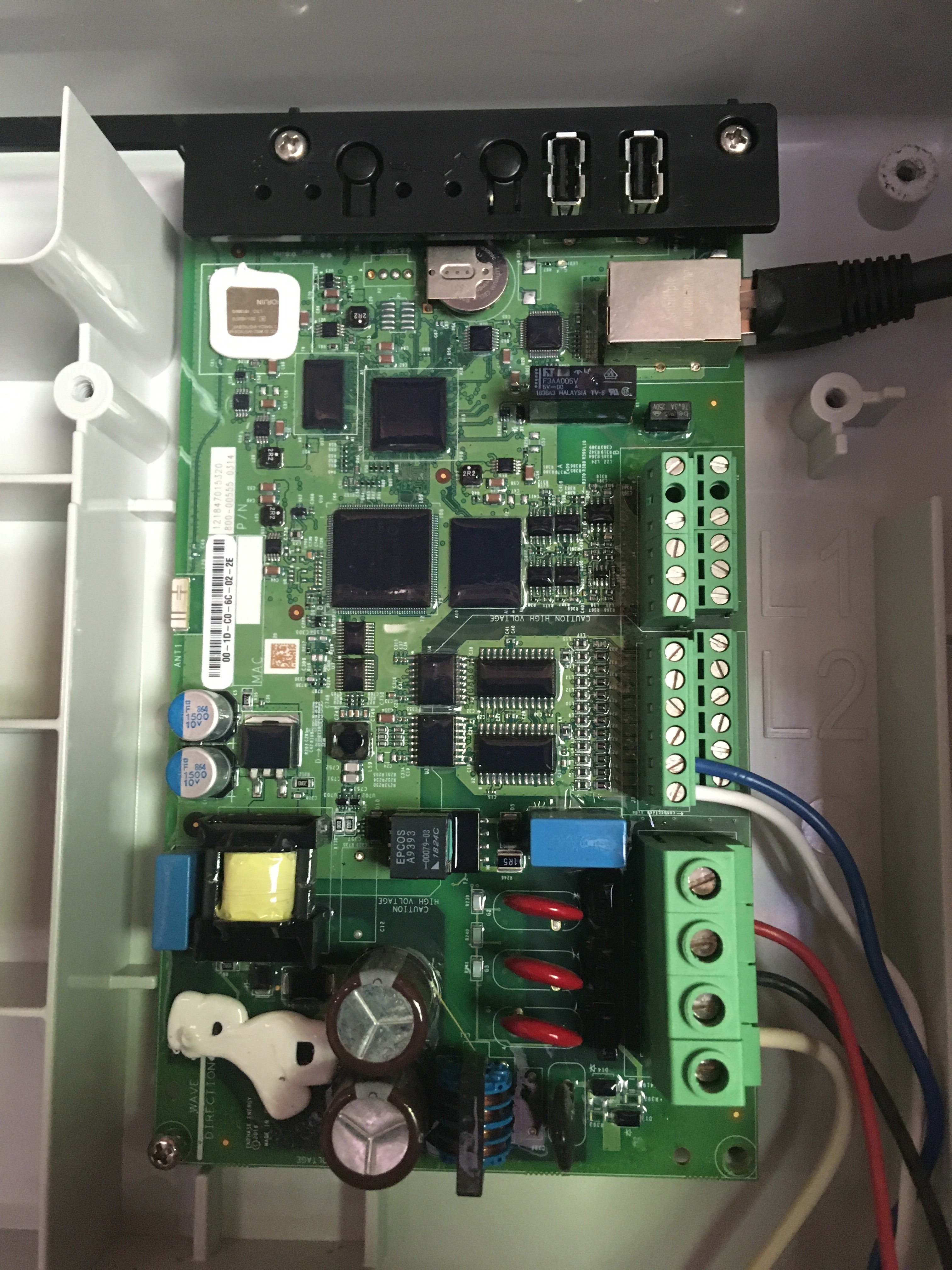
Now it's time to turn off the solar breaker in the power entrance panel. Then use your meter or one of those 110/220 voltage detector pen-shaped thingies to double check that power is off. Mine is made by Klein and very reliable. Once you have done this, use your cell phone or tablet to take a close-up picture of the Envoy combiner box wiring for reference. Here's the one I took:
I didn't need to photograph the breaker wiring because the cut-outs on the dead panel told me where the breakers should go. You may have more breakers so you may wish to do this.
Then remove the breakers. You don't have to disconnect the wiring. Just pry them gently away from the bus bar. Using a small flat screwdriver, disconnect the wires that go directly to the Envoy, in my case the small white and blue wires from the transducer, the three 220v wires that power the Envoy, and the ethernet cable to the Envoy. Then, using only a Phillips number 3 screwdriver (not a bloody great cordless impact driver) carefully unscrew the Envoy.
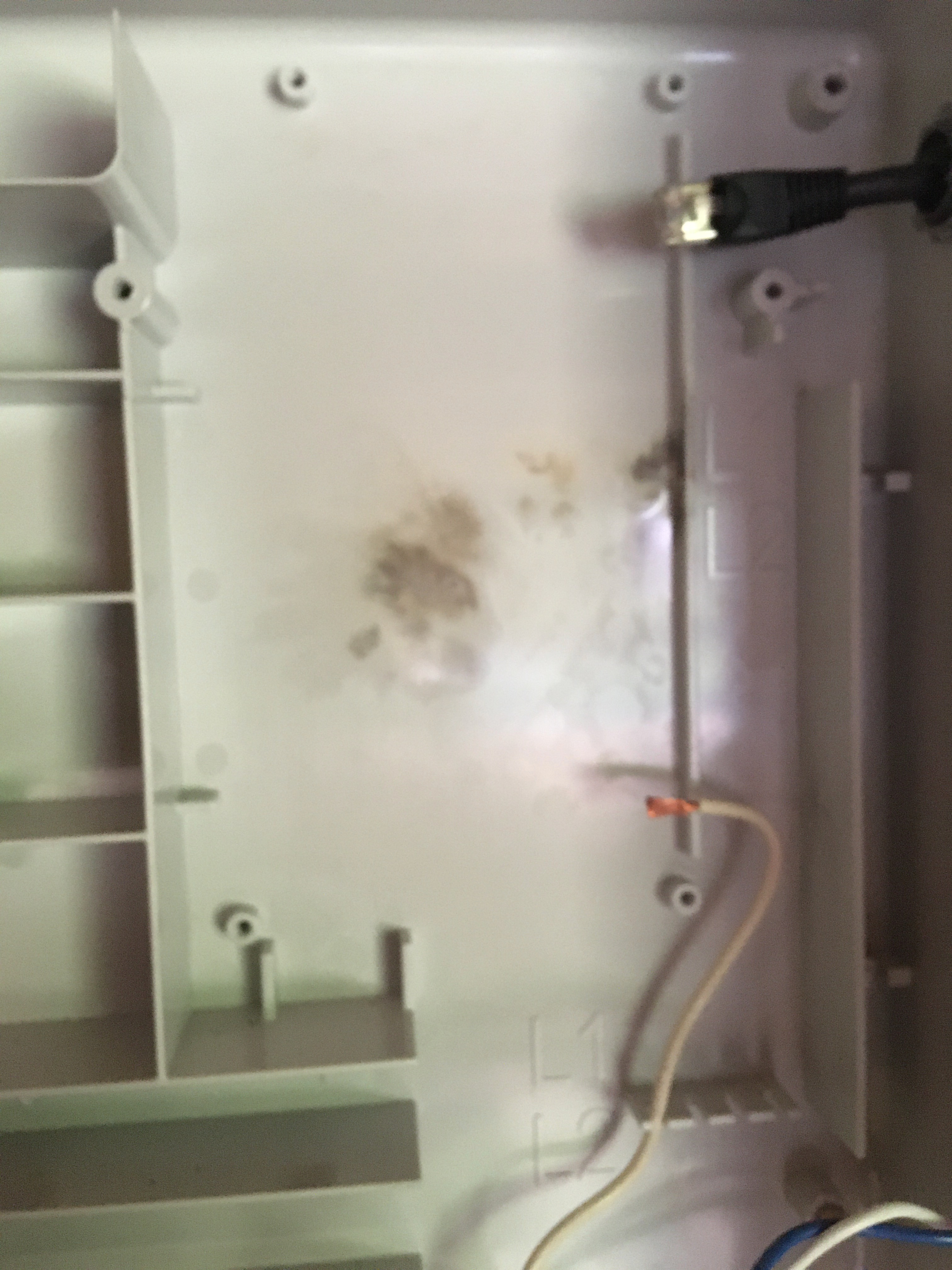
If your Envoy got fried by the lightning strike there will most likely be some discoloration of the printed circuit board (PCB). With mine you could smell it; there was a little whiff of burned wiring. There may even be a little soot on the PCB or on the surrounding plastic box, like this (below):
Here's the kind of discoloration you'll look for:
You can see grey marks around the spots of solder where excess voltage has fried the PCB.
Time for a new one. Order direct from Encase using their online shop. Your new PCB will arrive in the mail. You'll fit it, reversing the procedure above. make sure all the connections are in the right place using the picture you took earlier. They sent you a sticker to replace the one you had with the Envoy serial number. this goes on the door of the combiner box.
Then turn the breaker in the power entrance panel back on.
You should immediately see four red LEDs where, when your system was working, you used to see four green ones.
Now you have a choice. You can call or chat with Enphase corporate and have them update your Envoy's serial number in the system, then wait for your system to boot up and send data to Enphase and update the Enphase consumer interface, which can take up to 24 hours or more. Once everything is properly booted, you should get four green LEDs and be able to see from Enphase that your system is now working.
You may need to use the Enphase website or have Enphase themselves update your grid profiles. Rebooting with a new Envoy resets the grid profile. This is a set of instructions that the Enphase server sends to your inverters, telling them when to turn on and off based on local grid requirements.
Here is what Enphase wants you to know about grid profiles.
You can get in trouble with your grid operator if you use the wrong profile. You may need to call them to find out what the profile is supposed to be. The national default is IEEE 1547 2015.
But better and faster than this, you can go to the Apple Ap Store and download "Installer Toolkit" to your phone or tablet. If you have this software, you can switch out the Envoy serial numbers themselves using the "replace Envoy" function, update your grid profiles yourself, and see if the new PCB is working. If it is working your inverters will be pushing power to the grid and you'll see that in the Toolkit interface.
There's some scuttlebutt in comments on the Enphase website that mere mortals can't download use Installer Toolkit, but I was able to get it. Give it a try.
Enjoy.