Showing posts with label wind turbines. Show all posts

Thursday, August 12, 2010

Penultimate field project of the summer


Our anemometry field work, having given us difficulties all summer, is finally starting to get easier.

Easy is relative, of course. It's never easy to wrestle these huge steel towers by hand up and down the state of Maine. Several times this summer I've wished for a team of mules or a tractor with some kind of super duper four wheel drive, anti-tip-over system.

With backhoe, loader, trailer and forklift permanently attached so you could use whichever you wanted any time you needed.

I don't think they make those, but if they do, that's what we'd need. That and the mules.

But what we have instead is sweat, sweat and more sweat, elbow grease, and of course, old fashioned brute force and ignorance.

Did I mention the sweat?

Anyway, sweaty scene-setting aside, there is a purpose to all this hard labor. We're trying to measure the wind for serious scale wind turbines on community-owned, state-owned, or farm business sites. About the only place we won't measure the wind is a private residence that happens not to be a real farm, ie, more than 50% of income from farming. Those we don't do. Nor do we measure wind for small scale turbines that are cheaper than anemometry equipment. That's a no-brainer.

And we don't measure for large scale commercial farms, although there's nothing to stop a Maine town government putting in a substantial, money-making, green-power making, community-owned wind farm if they so wish, such as the Fox Islands Wind Project (one of our anemometry sites earlier this year).

But if you're a farm, a town, a non-profit, or a branch of the state or federal government, we will help you out.

All the data is in the public domain, and anyone who wishes and has the knowledge to use it can contact me and get a full data set for any of the sites where public money has been used to pay for equipment or labor. Of course, this is data, so it's not very interesting unless you can crunch numbers, but we give it out for free to anyone who asks for it.

We also use the same data to read the Maine wind map very carefully, correcting intuitively where we can, and we make custom poster-size or computer-file GIS-based wind maps for anyone who asks.

At this point we have good data from enough sites in the state of Maine that we can correct the wind map for a lot of places. Not all, but enough to begin to save people time and trouble. We have enough anemometry data from our sites and those run by our partners, the University of Maine's anemometer loan program, that if you have a site in mid-central Maine, we can in some cases give you a fairly accurate wind assessment without needing to measure the wind.

Other parts of Maine, not so good. The wind map, which was made for the federal government by a private contractor in 2007, has been inaccurate enough in three or four places that we know of to encourage a project on an unsuitable site, or discourage a suitable one. We need to measure in other areas, eastern and northern Maine, and then correct the map properly, scientifically: actually correct the algorithm or wind model the map is based on.

Bit by bit, we're getting out there. This is a five or ten year project.

Yesterday's job was to finalize our biggest project of the summer, the Mercer site. This is a private farm where the owners are interested in having a farm turbine, possibly with their neighbors or community involvement. It's a mid-central Maine hilltop in a region were the wind map numbers are most inaccurate. We have sites in this region where we've measured the wind and found it to be stronger than the map number by two full wind power density classes, a Class 4 site instead of a Class 2.

Oops. Need a number check, please.

So we wanted a bit more data on that issue, and the owners wanted data to decide on their turbine, and there was federal and state money available through USDA and our partners the Efficiency Maine Trust. Maine Rural Partners, a regional agricultural advocacy organization working for farm energy efficiency and commercial viability, among other desiderata, did the outreach.

But the sweat, dear readers, was all ours. Although we had a good deal of useful and sweaty help from the farmers.

This site gave us more than the usual amount of trouble and at least one of the wind workers said that she was "done with" driving out there even though it has a nice view and there happens to be a good coffee shop along the way. We put in about fifteen or maybe twenty field days on this site, not counting the six or seven days to initially recover the equipment from the previous site, which itself was a very inaccessible mountaintop, requiring each component to be carried about half a mile down a steep trail.

The problem with Mercer was the clay soil. It had clay pan at 2-3 feet, very well drained this time of year, and hard as iron. This clay defeated no less than three different power augers, each increasingly larger and more powerful. You could chisel it away in small chunks with an iron bar, each blow requiring the full force of a pretty strong guy, but that's no way to run a railroad.

Eventually we got a back hoe and dug big holes and buried nautical-style "deadmen" anchors, using recycled wheel rims slipped over our screw-in anchor rods. There's nothing quite like a rusty sixteen-inch wheel rim under four feet of clay or glacial till, rocks and all, to give you a decent anchor. (Thanks to TA's Automotive and Salvage, a very fine and public-spritied organization, for the rims.)

Earlier this week we pull tested similar anchors at the University of Maine's Peaks Island wind site to 4,000 pounds. They would have held more, but that was already 500 pounds more than the required load, so we left off at that.

Here's wind worker Steve on the ferry to Peaks, looking positively vacational. Don't worry. By the ride back, he was good and sweaty.


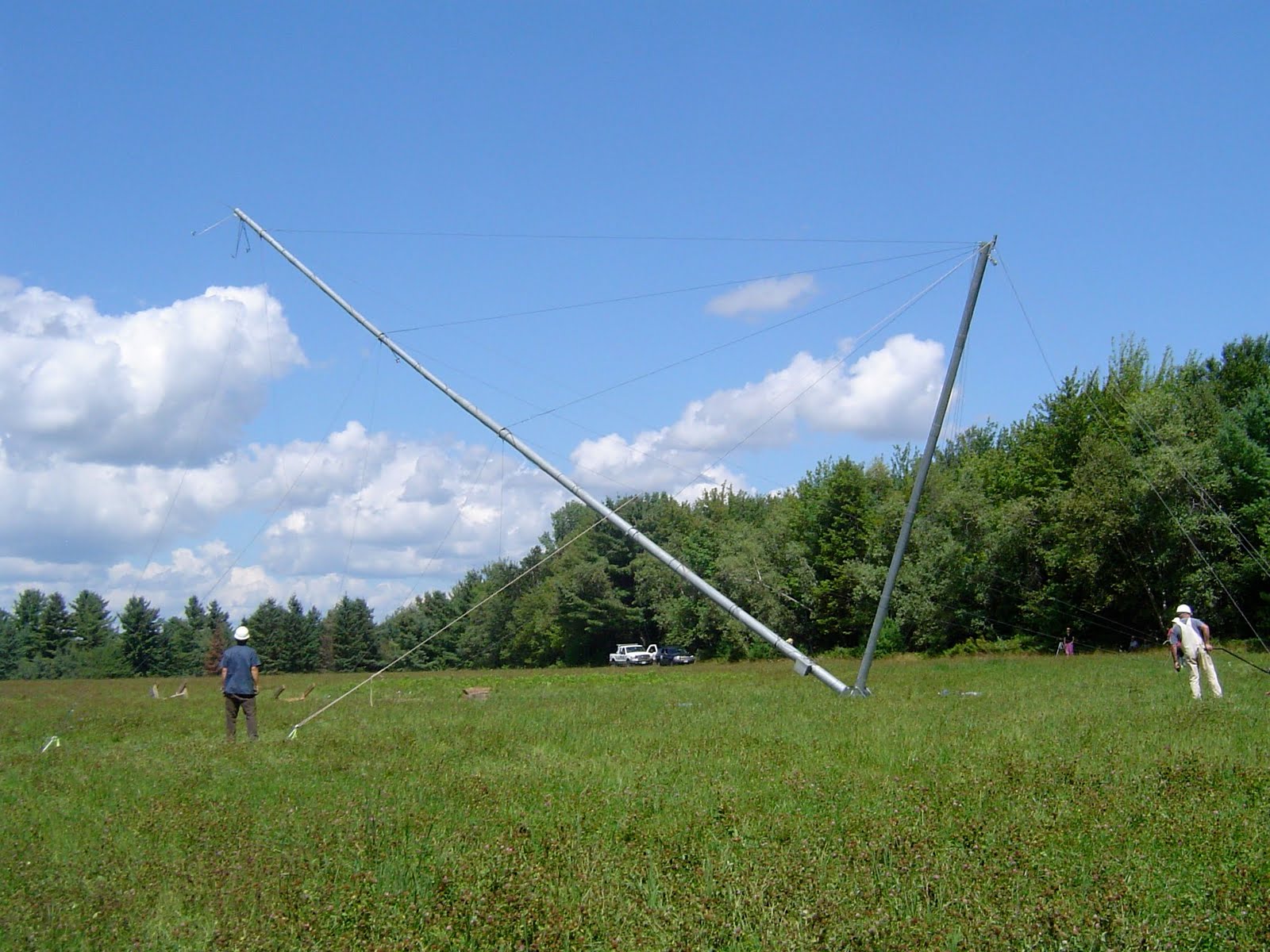
The equipment we used at Mercer was a NRG Systems 60 meter tower, which we reconfigured as a 30 meter tower for this site.

Although we started our wind program four years ago with the 60 meter equipment, the University of Maine started with 30 meter, and since we need compatible data to correct the wind map, and since 60 meters is twice as big and twice as scary, and finally, since the community partners are usually thinking of smaller turbines, we decided to use 30 meters from here on out in most of our program.

That means we get to make two 30 meters out of each 60, although we have to buy some extra base plates and guy lines to do this.

The NRG towers are called "tilt-up" towers because they hinge at the base plate, and are lifted by a winch and a "gin pole." They flex a lot and make scary noises going up and coming down. Sometimes they fall down, especially if you're inattentive to the cable tension as you raise or lower the tower. We had one fall down earlier this summer. Not for the faint-hearted.

You need to be an experienced rigger, and even then you need the NRG Systems training, to think about working with this equipment.

(The Mercer site equipment was given to our wind program by both NRG Systems and Competitive Energy Services, for which we are grateful.)

Long story short, with the deadmen and recycled and donated equipment, we were able to get an anemometer on the Mercer site for much less than the going costs. And we're collecting data that will be in the public domain. It will be accessible and free, and if you are a community organization in the mid-central area, this data will allow you to rule in, or rule out, a community turbine, for free.

When it would normally cost between $20,000 and $50,000 depending on the height of the anemometer tower. This expense, and commercial competition, means that private wind power developers generally keep their data secret.

We don't keep data secret. We collect it using public money, and so we give it out for free. We think this is a good deal, since there are very few communities that can afford this. We also feel that public wind data is more efficient and valuable than private data. This is, after all, very basic science, and although the commercial value is high, if the data is privately held, no one is looking at it in a coordinated way, and that costs everyone.

The data can also be used for proper public planning, since the turbine noise nuisance varies based on the wind. Towns and municipalities can properly plan to reduce noise, another good reason to think that public data is better than private.

We have one more day today at the Mercer site, a clean-up day. After that we have one more site to set up this summer. Then we're done with field work for a while.

Which is good, because although I enjoy the work, and although I need the exercise, I am a little tired of all that sweat. It will be nice to go out to these sites in fall and collect the data when it's a little cooler.
Saturday, February 28, 2009

How noisy are wind turbines and wind farms?


This came up recently in response to a question from a resident involved in the wind power debate currently underway in several local towns.

Industrial wind turbines are large pieces of electrical generating equipment with moving parts, particularly swishing blades and humming gearboxes and generators, and so no-one should ever imagine, or try to get away with saying that there won't be noise.

The question is, how much noise will be created?

It's also important to ask where the noise will occur.

When is irrelevant. Although Maine's Site Location of Development Law allows for higher noise from new developments during the day than at night, you can't turn a wind turbine off at night.

The Site Location of Development law on noise boils down to one requirement, after you strip away a lot of fine print, and apply it to turbines which cannot be shut off at night: wind turbine noise may not regularly exceed 45 dBA at any location where the owners have a reasonable expectation of quietness, ie, any home in the countryside in Maine that wasn't built next to an already noisy industrial plant that existed before the home as built.

The GE 1.5 MW models currently used for all major wind power developments in Maine produce about 100+ decibels (dBA) at the turbine head at full-out operation, and about 54 decibels at the base of the tower. The sounds are reduced the further you get from the tower, until they blend into the background noise and can no longer be detected.

Because wind itself produces noise in trees and around buildings, while the turbine speed doesn't increase much after the peak operating speed of 8 or 9 meters per second is reached, the windier it gets, the more background noise there is, while the noise of the turbine remains the same. On a breezy day, woods and trees can produce 54 dBA quite easily, leading to the paradox that turbines are effectively less noisy at higher wind speeds than medium ones.

However, in Waldo County, Maine, we have primarily medium wind speeds of Class 2 and 3, leading to the paradox that turbines are effectively more noisy here than better or worse wind power sites.

Go figure. But it's true.

How quickly the noise reduces as the distance from the tower increases will also depend on the reflective or absorbent qualities of the terrain. Trees are better than open ground. The graph above is for a wind farm in wooded land in New York state.

If you place one or more wind turbines close together in a wind farm, there will be more noise than there would be from just one turbine. The manufacturer publishes data on the noise of just one turbine. The developer must mathematically model the noise from several turbines to predict the noise level at any given site. If a developer is proposing a wind farm, Maine jurisdictions and communities should look to see that the modeling has been done, so folks can be sure that the developer's noise impact predictions in planning applications are not based on just one turbine.

Based on the New York study above, the likely distance or setback that will meet these requirements is probably somewhere between 300 and 400 feet for GE 1.5 MW wind farms in woody sites. This is not to say that neighbors won't hear the turbines at 400 feet, just that the legal requirements will be met, and so the DEP will likely approve the permit, assuming all other requirements are met.

I have heard a rumor, but not had time to confirm, that GE has recently recommended a much larger setback of 650 feet for their 1.5 MW models, while the European countries tend to use an even higher standard of 500 meters.

The primary reason for these higher setback recommendations, as I understand it, is not noise, but ice throw safety. Turbine blades can accumulate ice during ice storms and other suitable weather conditions, which can get thrown off. The industry standard recommendation for ice throw safety is 1.5 times the turbine height.

Even with the 650 foot setback recommendation, it will be possible to locate turbines on sites in Waldo County and meet the requirements of the Site Location of Development Law. Towns may, however, enact stricter regulations, should they choose to do so. Care should be taken if towns decide to control turbines using noise performance standards because many agricultural and industrial operations will fall foul of the new regulations. It's probably best to require a setback specifically for large turbines instead.

Not all turbines, just the large ones.

The little camp owner or homesteader who wants to run a little Air-X or Skystream 3.7 household turbine shouldn't have to have such a big setback.

Wednesday, February 18, 2009

Peak's Island Wind Resource Assessment


Can you say "anemometry?" I have a really hard time getting it out. But that's what we're about these days. Wind resource assessment is easier to say, so maybe that's why it's the standard term.

But anemometry is more fun to try to say. Try saying it six times fast.

I went with Sustainability Design and Technology student Cody, and Efficiency Maine's Environmental Educator, Katie, to do a preliminary survey of a wind assessment site on Peaks Island, Maine, and to give a community talk on wind power and wind assessment.

This is us on the ferry. I always enjoy Maine islands, as they remind me of Scotland.

The best place to put our anemometer tower, we determined, was at the top of this old WWII lookout tower. Back in the day, the German subs would lie off Portland and try to sink the liberty boats as they left the harbor for good old Blighty.

So we can put this very old building back to good use. That's what I call recycling.

The next picture is of Cody at the top of the tower.

A 360 degree view of Casco Bay and the Gulf O' Maine. A five-star anemometry study site if there ever was one!

On the ferry home, the lights of Portland were spectacular in the clear night sky.

All in all an excellent field trip and immersive educational experience in community wind assessment and planning for Cody and Katharine. Thanks to the Peaks Island Environmental Action Team for being our hosts, and especially for taking us to such a great community suppah!

For more details on Community Wind Assessment, a program of Unity College Center for Global Change and Sustainability, click here.


Saturday, February 14, 2009

Renewable power in Jackson, Maine


People are getting upset about energy in Maine again. This is not surprising. In such a cold wintry place, energy is vitally important, and anything that important is always controversial.

The most recent controversy is over wind energy in Jackson, my home town. Which is funny to me since Jackson is really a beautiful almost unbroken, rolling hilly forest, and energy here is abundant.

Our old Maine farmhouse runs primarily on Jackson-made energy from recent sunlight, and far less on fossil fuel (which is really ancient sunlight) from away. As a professor who teaches about energy efficiency and renewable energy, and as a climate policy wonk, this is important to me, and has taken a fair amount of effort with insulation and caulk and spray foam to achieve.

But it does run on sunshine.

Visitors are often confused, however, when they look for the solar panels and wind turbines that most folks seem to expect when confronted with a "green" house. But the fact of the matter is that it isn't quite that hard or expensive to run a house on green power.

The primary source of green power at our house is sunlight. This is collected by 15.5 acres of grass and trees. The grass goes into eight sheep, who use it to make meat and fleece. The meat we eat, in the form of surplus lambs. The fleece, most recently, has gone on to a student's experiment in fleece insulation, of which perhaps more later. But it's really the trees that are the thing.

15.5 acres of fairly rapidly growing trees is about 15 cords, or 1,900 cubic feet, or 54 cubic meters of new wood per year, primarily hardwoods, primarily ash. This is about 20,000 kilograms, or 20 metric tonnes. That much ashwood contains 350 million btus of energy, or about 103 megawatt hours (MWH).

We only use a little more than a third of this production. The rest is sequestered in the growing forest. This helps make up for the fact that our current forest management regime is intended to reduce the smaller trees to make room for grass for animals, leaving larger ones for firewood and cover.

So that would be about 33 MWH total from firewood.

By the way, when I see the bright orange light from our woodstove door, I immediately think of the stored sunlight it represents. This is a comforting thought, especially in the middle of winter.

The next largest supply of energy is from electricity. We purchase our power directly from a company that owns and runs wind turbines, and that aggregates power from Maine hydrodams. There are environmental impacts from both, but the hydrodams have been in place for many years, and are more or less accepted parts of the Maine landscape by now, with their own ecologies and human and wildlife communities, so we opted for hydropower. In the future we may switch all or part to wind, mostly to show support for this new Maine industry which I find valuable, and which is beleaguered by local environmentalists and neighbors. But for right now, our power comes from hydroelectric dams. It gets put into the grid, and the electrons set in motion by the spinning generators at the dam get mixed up with all the other electrons, but we take out as many as are put in and as we paid for, actually less electrons than are made to move for us, taking into account transmission losses, and so we purchase and use moving electrons, or electricity that is made by hydropower, which is also made by the recent sunlight that evaporated the seawater and river and lake and groundwater that became the rain that filled the dam.

So again, we are running on recent sunlight.

Our house uses about 4.8 MWH/year of electricity, mostly for light, entertainment, and refrigeration, but also a little for heat. This is a little less than the national average of about 10 MWH/year.

The house uses about 850 lbs of propane, a fossil fuel, which is about 0.38 of a metric tonne, and contains a further 5.3 MWH of energy. This is very old sunlight, and is used for hot water and cooking.

Finally, because heat energy from wood is less regulated, and requires our presence to feed the woodstoves, we run an oil furnace in the background all of the time in winter. This is also very old sunlight, and its use in our house is strictly controlled; and so it only takes over when the heat from the woodstoves die, or when I decide to nudge up the thermostat to take the chill off more quickly than the woodstoves can. The furnace thermostat is set to 60 degrees F, and so on a cold day it kicks in a few hours after we leave. This uses between 50 and 150 gallons of number two heat oil per year, an average of 100 gallons, a further 4 MWH.

So the total of all this energy is:

Firewood: 33 MWH
Hydropower: 4.8 MWH
Propane: 5.3 MWH
Heat Oil: 4 MWH
Total: 47.1 MWH

Percentage of total household energy consumption that is renewable is 37.8/47.1*100, or 82%.

We could definitely do better than this, but to be reasonable, we also drive two cars, which together consume about 600 gallons or 2,700 liters of gasoline, which is another 25 MWH, quite a lot more energy. Since we can save some of this energy simply by only driving one car whenever we can, which also saves quite a bit of money, we would be financially better off right now not by trying to save more household fossil energy consumption, but by trying to carpool more often. These last few weeks of the spring semester we have been able to carpool an average of 60-70% of the time, which compares well to last semester's 30-40% of the time. Of course, our ability to carpool is directly related to the timing of the teaching and meeting schedule that Unity College gives us. If our schedules are at normal 8-4 working hours, then we can carpool. If not, if one of us has an early or late meeting, the other must either leave late or come home early to feed the animals and the woodstove.

The extent that we are able to carpool, and the amount of time that our cars last, is also directly related to our ability to save money to buy new energy-saving appliances and equipment for the house, or to buy a more efficient car.

This is all a pretty carefully constructed system of rational trade-offs, I guess. But it works for us and we are able to progress towards less overall fossil energy use per year. We are reaching the limits of what can be achieved cheaply with insulation and caulking and firewood. The next stages -- an electric or plug-in hybrid car, a new solar thermal hot water system, possibly combined with an electric on-demand hot water heater for when the sun doesn't shine, these are all relatively expensive.

But even then, the heart of the system will be the 15.5 acres of woodland, whose green leaves we hope to see spread soon this spring to catch some more of that sunshine for us.

Just recently, a group of our neighbors from Jackson, Maine published a newsletter and web page opposing the wind power developments proposed for the Mt. Harris ridgeline to the north. I probably know that land as well if not better than anyone, since I explore it extensively each fall while teaching map reading to the trainee park rangers and game wardens of Unity College, or on my own or with Aimee on Sunday walks.

It is a very beautiful area, the scenic jewel of the Great Forest of Jackson and Dixmont.

There may be quite a lot of very large wind turbines on that hilltop soon. Our neighbors are really anxious, and many do not wish to see the turbines go ahead. They are asking a lot of very awkward questions at Town Meetings and in their paper and web site.

For my part, I think the company, which is the same one I get my hydropower from, should perhaps think about a few less turbines. While my neighbors might think about accepting a few, or even getting one or more that are owned by the community.

As for my neighbors, I wonder if we sat down together and added up all our energy consumption and studied all the difficulties and problems that are caused by each and every kind of energy, well, I wonder if we might not then realize that the turbines are possibly a better investment than patrolling the Persian Gulf, or building new nuclear power plants, or waiting for climate change to revise the entire north-eastern forest ecosystem.

The problem is, I think, a) we don't do that. Instead we shout at Town Meetings. And then b) even the country as a whole doesn't do that, which is why a power company I otherwise support can get away with turning this part of Maine into an energy exporter for other parts of the country, essentially an energy colony. And then c) I'm a very boring, very rational old college professor who just wants his students to grow up fast, and put away childish things like yelling at each other, and think about it as well as they can.

Believe me, I understand the limitations of my wishes very, very, ruefully well.

I don't believe in black and white when it comes to energy. Even my firewood pile, which is probably one of the cleanest forms of energy, still produces solid waste in the form of ash, air pollution in the form of particulate, and environmental damage each time I cut down a tree and cut it up for firewood.

A few wind turbines on Jackson ridge would probably be a good thing. They might help us all learn to run as much as we can on recent sunlight here in Jackson. I for one would like to use this energy. It would be better if the community could get the most benefit out of them, particularly if we owned one or more of them, and it would be better if there were less of them than are proposed.

The community probably has it in its power to require some or all of this, but it would take a good lawyer to figure it out. To begin, we might start by doing our energy sums.

Wednesday, February 11, 2009

Cheaper power from wind -- it works!


Wikimedia Commons image of wind turbine installation


I get a lot of questions from the general public on wind power and community wind. One set of questions, asked a few weeks ago, was 1) how much of our total electrical power we might expect to produce from wind turbines?, 2) whether that was really significant in terms of our energy problems?, 3) whether it would lead to reduced prices for power?, 4) reduced greenhouse gas emissions?, and 5) closure of coal-fired power plants?.

I had responded that we didn't yet know all the answers to these questions, but that we had theoretical answers, and more practical information was beginning to come in, from the countries that have the most wind power already installed, Denmark and Spain:

http://www.guardian.co.uk/environment/2009/feb/09/windpower-spain gives a good idea.

1) How much of our total electrical power might we expect to produce from wind turbines?

This is normally given as 20%. The Danes are at about that right now. The article above shows that this number can be exceeded for short periods of time.


2) Is this really significant in terms of our national-level energy problems?

I think so, although if you were looking for a silver bullet, you'll have to keep looking. All energy choices require some sacrifice in terms of money, pollution, or land use. If energy were free and always present where needed or wanted, we'd have colonized Mars and Venus by now, and we wouldn't be nearly as worried about human life on this planet! In economics, particularly in markets controlled by cartels like OPEC, small percentage points of difference can make a very big difference to the outcome of some models. The "swing share" phenomenon in oil is a case in point. It was only a 10% shift in production from the middle east to Alaska and the North Sea that resulted in the $10/barrel oil of the 1990s. In this case, a serious effort in renewable energy production that meets anything like 10, 15, or 20% of our needs in the electrical sector will tend to make more of a buyers market for oil and gas, which will improve national security, given that oil and gas revenues boost the military capacity of countries hostile to the west, such as Russia or Iran, or encourage those western countries we have political difficulties with, such as Venezuala.


3) Will wind power development lead to reduced prices for power?

I tend to think that the Spanish example in the article can be duplicated. The nature of wind power is such that the cost of power is shifted from fuel to plant. Plant lasts longer, has a stable price, and maintenance and replacement/refurbishing costs can be amortized. This fits the definition of "sustainable" capital from Daly (and Hicks). Wind power may well act as a defense against inflation in macro-economic terms, because it is not consumptive of fuel, whose price is a driver of inflation. The key is to get the plant built, and I imagine Spain is enjoying it's success with these wind farms right about now.


4) Will wind power reduce greenhouse gas emissions?

The Danish grid helpfully produced an English language version of it's environmental report here, showing unequivocal reductions in greenhouse gas emissions, some large proportion of which is attributed to wind power development (the rest being conservation and energy efficiency). There are also reductions in conventional pollution from mercury, nitrous oxides, and sulfur dioxide.


5) Will wind power lead to closure of coal-fired power plants?

No, not right now. The base load problem is still present. Wind power doesn't work all the time, and so you have to have some better base-load system for when power demand cannot be met by wind. Coal, nuclear power and oil are the usual choices. Natural gas, hydropower, large scale solar and nuclear power are useful peak load technologies.

But smart grid and distributed power production thinking and technology will allow us to incrementally reduce the percentage of power needed for base load as we install wind capacity. So it may be possible to phase out coal plants one day directly because of wind. An example of this kind of radical thinking is the recent proposal to build peak-use solar power stations in some spots in Maine, rather than to expand the current transmission network and connect it more thoroughly to the New England regional grid. Another example are the prototype Hyperion nuclear power plants for distributed power use. A third is the idea that plug-in hybrid and battery electric cars can collectively form a national power storage system.

More importantly, wind power reduces the need to run coal and oil fuel through these power plants, reducing greenhouse gas emissions immediately, as soon as a new turbine gets plugged into the grid, This also reduces the need to build new power plants.

Wednesday, February 4, 2009

Finance trickles, turbines now cheaper

No cloud comes without a silver lining. In this case, you can now actually get your hands on a turbine - IF you can get your hands on some money. Previously you had a long wait.

Since I'm helping shop for one for the high school right about now, although we're still at the analysis stage -- fitting the right turbine to the site and the budget -- this is both good and bad news.

http://www.nytimes.com/2009/02/04/business/04windsolar.html?_r=1&hp

Actually, now I remember, I'm shopping for two. As well as a 75-100KWH one for the high school, I have to get a tiny one too, <1KWH, for the college's Eco-Cottage (a student dorm that runs partly on solar and wind).

Baby wind turbine and momma wind turbine. Where's daddy bear?

Wind power doubles in a year, finance slows to a trickle in US

http://www.guardian.co.uk/environment/2009/feb/03/wind-power-eu

Tuesday, February 3, 2009

Question on community wind revenues

Dear Mick,


Just one question for now - how is community-owned wind more efficient that than the industrial turbines, unless it goes into a locally-controlled grid? (I'm not aware that such things exist). I know you also mentioned this with the Mount View project as well, trying to match generation to use.


Doesn't everything go into the New England grid and get sold through contracts to whoever? (eg. I understand the Freedom project has a contract so sell to New Hampshire).


Dear XXXX

No. That notion applies to big producers like Freedom, who must find wholesale buyers and also make up money selling Renewable Energy Credits (RECS). But for smaller community-owned sites, the Public Utilities Commission of Maine has a series of regulations that allow...

1) Net metering for small energy producers (Title 3, chap 313). Allows small generation facility owners to get retail price credit for power the produce, even power they put into the grid at one place (meter) and use at another "in the vicinity," up to 100KWH. So this creates a value of 12-15 ¢/KWH for facility owners rather than the wholesale price of 0.5 to 2 ¢, up to a point.

2) Aggregation for surplus KWH (Chap 315): Small facilities owners can save up KWH they produce at windy times, and times of low power demand, as credit, and use it at other times. After the maximum allowable, they have to accept wholesale price.

3) Provisional rule on shared ownership (Docket 2008-410). A group of individuals can share in the ownership of a generating facility, as a co-op, a non-profit or for profit corporation, or as a branch of a municipal corporation and use rules 1 and 2 to create and aggregate KWH credits at retail values. That means that you and a bunch of Jackson neighbors, or the town, could put up a turbine in a windy spot and get a high retail value for the power produced, up to a point (100KWH/hour rated equipment), and use it to pay everyone's power bills.

Not as easy as it sounds, quite a bit of small print, but that's it in a nutshell.

And the power generated on site close to homes and other demand sources means that less coal, oil, natural gas, or nuclear power is used elsewhere. Those sources are powered down a fraction as turbines come on line. Also, because production is closer to demand, there are fewer losses to transmission, which losses are considerable, so there's a "double dividend."

Finally, the CO2 produced by the production of wind turbines and their lifecycle use is about 1/100th of that produced by regular power generations systems.

I will post this on my blog, having deleted your name and email, as it's an answer to a series of commonly asked questions.

Mick

Saturday, January 24, 2009

How much power do wind turbines make? and other questions

With a new wind turbine siting process looming for Waldo and Penobscot Counties (the same proposed wind farm straddling the county line), I'm getting numerous technical questions about wind power. The following is my response to one such question. A previous response, also germane, is at this post here.

(I often get asked the same question or much the same question several times by members of the public so I like to post the answers.)

Another question I got asked recently is, "why can't the State/Federal government do more comprehensive land planning for wind turbines so we can minimize the clashes with other important land uses such as tourism? Why do we always have to do it piecemeal?"

The answer to that one is, you don't have comprehensive state or federal-level planning regime in this country, in the same way you do in, say, most European countries. Since a key court case, Lucas vs, South Carolina Coastal Commission, and other confirming judgements, the only planning system with teeth is municipal or county zoning. If the zoning regime permits a turbine, the landowner or developer with a lease is going to be able to build it. So the impetus is on developers to propose sites. You can see a paper relating how we got in this particular fix in my chapter in Matthias Ruth's edited anthology Smart Growth and Climate Change, if you're serious about getting a full, reasoned answer to the question.


Dear Mick:

Several of us Thorndikeans [Thorndike: local town] have decided to form a citizens committee to research potential risks -vs- benefits of wind turbines. I thought since you are involved in the Mount View project you would be interested to know this is happening as the decisions made could impact that project and second, to ask you for some sources of information. I am seeking information about the economics of wind power. I know that wind is the most cost effective per watt, but I am looking for the larger picture. How much power can a wind project of this scale (say 30 turbines) provide? Would it be a drop in the bucket compared to what our community is currently using power wise or could they make a significant difference?

My goal is to gather enough sound informationto make an understandable presentation and then let people choose for them selves wether or not wind power is a good- albeit sometimes noisy, sometimes flickery- way to generate energy.


Dear XXXX:

The question you ask is fairly straightforward, but the details get technical fast.

First up, the costs and benefits. I'm going to direct you to a letter I sent XXXX, a former student of mine who was working with your neighbor, XXXX, to form some kind of wind power group. I got the impression, although I could be wrong, that XXXX were mostly worried about the negative impacts, so I wrote this letter to point out that there are benefits as well as costs. Very rational, I'm afraid, but that's what environmental scientists do.

You can get to it at http://ucsustainability.blogspot.com/2008/11/wind-turbine-advice.html

Let me know if you have trouble getting to it.

The main thing I would add is, since then, I studied up on some of the negative impacts of [another Maine wind power installation], and particularly questioning why their local noise level was higher than advertised. I think I know why, and how it can be avoided. It's most likely to do with the increase in noise when one turbine's noise is added to anothers, as well as the neighbor's buildings being downwind perhaps more often than was thought.

With better planning you'd likely be able to avoid these problems.

I would be happy to explain the noise characteristics of turbines and the aspect of site planning related to adding one turbines noise to anothers in abstract terms should you or your neighbors be interested.

As to benefits, wind power can be profitable, which is why private financiers are interested. Most essentially, the economics of wind power are not that different from the economics of any other industrial plant installation, where the primary factor is the interest on borrowed capital. Towns and municipalities can issue bonds with good interest rates, and so community-owned wind can be profitable.

The second factor is the site assessment work, which we are learning to do at Unity College, having just completed our first for Mt. View. The data you need is the frequency distribution of wind speed, not just the mean or average, and the power curve of a given manufacturer's make and model of turbine. There's a major increase in power produced per dollar of installation costs as the size of the turbines increases. The "square-cube law" applies. The power of a turbine increases relative to the square of the diameter of the swept area, and the cube of the windspeed, up to the cut-out speed of the turbine. This provides for a major economy of scale. Put simply, as turbine height and blade area increases, so KWH produced increases much, much more.

So, for instance, on the Mt. View site, using a medium-sized Northwind 100 KWH-rated turbine, the power produced according to our assessment would be 120-130 megawatt hours/year. Your house probably uses 6-10 MWH per year, so that's enough power for 10-14 houses. The turbine has a hub height of 32 meters and a 21 meter rotor diameter.

The GE 1.5 MWH turbines at XXXX have a hub height of 60-70 meters and a 77 meter rotor diameter. I would guess that they will produce each enough power for several hundred houses. Two orders of magnitude greater.

As you can see, the benefits increase greatly with larger turbines. Assuming the owners make 2 cents a KWH for their power, the 3 turbines at XXXX might bring in a million dollars gross per year. Likely they make more than 2 cents some of the time, with some kind of green rate. So, for instance, I pay 12.5/KWH cents to my power production company for hydropower because I want to use renewable power at home. That would be a lot more money.

A thirty turbine project would produce ten times the energy of a three turbine project, assuming it employed the 1.5 MWH models or similar.

So, in general, taking into account the effects on birds and bats, which have to be compared against negative effects from coal and oil and nuclear power, wind power is quite effective. There is, however, what's called the "base-load problem," which is just that the wind doesn't blow all the time in all the places where there are wind turbines. Generally, a good site is active 70% of the time, and up to 90%.

This means we'll still need to have up to 80% of our power from other sources. Hydropower is, however, a good base load supply in Maine.

The theoretical maximum load of regional or national electrical supply that could be met by wind turbines is usually given as 20%. We're nowhere near that yet in the US. The Danes, however, are set to exceed that this year for the first time, and plan to get up to 30% or more, so we'll see if they can do it. By the time they get to 30%, we'll be at 10% or less, so we don't need to try that particular experiment when they will do it for us.

I hope this helps. If you'd like more information, or you want me to explain any of this in person, I'd be happy to do so.

I hope you don't mind if I publish this reply on my blog too. It saves me writing it all out again when someone asks next time, as with the letter to XXXX above. I will make sure your name isn't on there.

Regards,

Mick

Mick Womersley, PhD
Associate Professor of Human Ecology
Unity College
www.unity.edu/facultypages/womersley
www.unity.edu/sustainability
www.ucsustainability.blogspot.com

Friday, January 16, 2009

Amish wind problems

I've been talking wind with an Amish wind turbine engineer. That's been sort of unexpected, and fun, for me, not just because of my own Quaker background, but because Amish are such communal and pleasant people, and because of the engineering problems involved.

Our Amish engineer, whose privacy I'll protect by not naming him or putting up photos, is developing a shop to produce wind turbines. The Amish generally don't have electricity in their houses, so these turbines are designed to produce compressed air. They use air for machine tools of all kinds in manufacturing. A lot of Amish farms are actually small manufacturing facilities, turning out anything from wooden park benches and cabinetry to, well, wind turbines. This particular plant will make small-to-medium turbines for farm-scale installation, each turbine connected by an air hose to a large compressor tank. By both saving lots of air in storage tanks, and by scheduling manufacturing and other shop work for breezy days, the Amish can have compressed air without doing what they normally do, which is run a small gas engine to run the compressor. Gas has been expensive lately, and not all Amish church meetings allow the use of gas engines, so there's reason to think that wind compressors will be welcome additions to the Amish toolkit.

The last Amish family I got to know, several years ago in western Pennsylvania, used air in a very tidy and well-developed shop to make harness and tack out of leather. The shop, with homemade bridles, saddles and harness hanging everywhere, was a magnet for every horsey person in a hundred mile radius, and business seemed very brisk.

(I once went hunting on Peter Brown's farm with the four sons of this family. Because it was far, they couldn't drive buggies over to the farm, so I picked them up in my vehicle, a 1975 VW bus, which I sill have. At five am on a back road in Pennsylvania, with four Amishmen and a hairy Englishman in a VW bus, all pacifists armed to the teeth, I wondered what might have happened if I'd been stopped for speeding.)

There are some interesting problems to solve with a wind compressor.

The first is the cut-in speed of the compressor. A normal wind generator has a certain mechanical inertia to be overcome before it will run. The level of inertia is related to the strength of the magnets used, or electromagnets, and the quality of bearings. In a wind compressor, there's a piston to crank, and the inertia level is related to the compression ratio of the piston and cylinder and their mechanical efficiency and lubrication.

This could lead to high inertia. If you don't change your compressor crank oil, if it's cold out, and if you have a high compression ratio, your turbine might not run at all until you get a fairly high wind. In any case, you'd be better off with a turbine blade design with an aerodynamic shape that can produce high torque at low speed, to overcome the inertia and get the compressor cranking. Manufacturers of off-the-shelf wind turbine blades don't make these kinds of blades. So our engineer needs to find a way to make, or have made, a different kind of blade, with a wider base and higher pitch at the base, than a normal skinny, high pitch, high-speed small generator blade.

Another problem will be telling customers fairly what the capability of the compressor is. With an normal gas compressor, the manufacturer's label will tell you what to expect, and unless there's something wrong, that will be what you get. In the case of a wind compressor, the amount of air you compress will depend as much on how windy a site you have, and how high your turbine tower is, as on the actual label efficiency of the compressor. The Amish are required by their religion to be fair in business practice and to give fair value. So our engineer needs to be able to relate wind speed to the power output of the prototype wind compressor, producing in effect a power curve for the generator to give to customers and potential customers, except in this case power produced will be measured in compressed air, not in KWH. So he needs to measure the wind on a prototype generator tower. I've provided some analog equipment to do this job, but a computer-logged system would be much better. We have several, but the Amish aren't allowed to use them.

Interestingly, the power curve will not be sigmoid or logistic as is usually the case with a wind generator. It will exhibit an exponential curve to begin, followed by a declining slope, because any piston-driven compressor loses efficiency/stroke as stroke speed increases (because of valve and air intake capacity limitations).

Finally, users of these wind compressors will need to pay close attention to air efficiency and storage efficiency. Most compressed air users tolerate a lot of leakage. The compressor needs to run to keep the pressure up, and you have to exercise the compressor at least daily, and bleed out water that accumulates in storage tanks, so a little air leakage is generally not such a bad thing, and a downright convenience when from the little valve at the bottom of the tank where the water accumulates. In the case of a wind compressor, unless you are willing only to work when it's windy, or have a site where it's always windy, you had better have good storage and little leakage. The customers will need an instruction manual that emphasizes efficiency and leak control.

These problems are all kinds of engineering fun, and, as my wife noticed yesterday, much more fun than teaching classes, so I've been Hanging out With the Amish.

Luckily we have students at Unity College in our Sustainability Design and Technology major who want and need to learn this kind of practical problem-solving engineering, so we can involve a couple of students in this exchange. Not a whole class, though. That wouldn't be fair.

As an added bonus, students will get an education in cultural diversity and sensitivity and be able to observe first-hand the case-study in practical ethics that the Amish just naturally are, which is not such a bad additional set of outcomes.

The compressor power curve problem is very good math, and statistics, for students to have to learn and apply too.

Saturday, November 15, 2008

Poor day for a wind turbine party


Today was the day our local wind development company held an open house at their new development of Freedom Ridge.

Not the greatest weather. But there was sufficient wind that these GE 1.5 MW turbines were spinning well enough.

The turbines were controversial within the Freedom community, and I wanted to hear how noisy they really were. You could hear them quite clearly at about 200 meters. I imagine that you can hear them from further away. There are definitely houses well within earshot.

The same company wishes to develop a site in my own town of Jackson, which was one reason they held the open house. Generally, the Jackson site is further from housing, although I'd have to see a map of the proposed installation to be sure.

1.5 MW/hour is enough to power about 1500 houses.

That about sums up the trade-offs. But for more, see a few posts back.

Monday, November 10, 2008

Wind turbine advice


Grainy picture of local turbines at dawn.

This was a note to a former student involved in the Great Maine Wind Turbine Controversy:

Dear Mick:
Up until now, a bulk of what I've been reading in regards to industrial wind power has been very negative, by and large. Could you recommend to me some websites, journal articles, reports, and other resources that speak of the pros and even un-biased facts about this development? I truly want to be thoroughly educated in all aspects of this topic and do not want to be tempted to take one side or the other without solid knowledge.


Dear XXXX:

Of the various options to provide energy that would reduce climate emissions, wind power is currently the most cost-effective, coming in at between 2 and 6 cents per installed watt, compared to upwards of 20 cents for solar, 10 cents for nuclear, and so on.

There are few renewable energy options that offer as good an economic return for communities and corporations. Because of their good economics, private finance is interested in them, hence the developer's interest, but they also will help keep electricity prices down for ordinary people, compared to other sources of power, assuming fair competition and regulation in power generation.

So they are beneficial to owners of stocks and shares in energy companies, which are, like all stocks, often owned by ordinary people through pension funds, etc, they provide jobs in wind development corporations and maintenance contractors, although these are mostly specialized engineering, development, and finance jobs, and they can help keep electricity prices from rising as fast as other energy prices.

Local jurisdictions can benefit from taxes, and landowners benefit from lease payments.

Wind power also helps meet state and federal goals for energy independence. The current war in Iraq, for instance, which costs taxpayers an awful lot, and requires a lot of death and destruction, is at least partly over oil, and might not be so likely to be repeated if we develop our national wind power resources, as well as other clean, independent energy.

(There are many different kinds of ugliness in the world.)

I can recommend a good book on wind power control and development that covers all of this quite well. I have it in my office, and you can take a look at it when you come.

Then there are the ecological benefits.

Most climate scientists expect that to abate dangerous climate change of 2 or more degrees Celsius in the next 100 years, we need to reduce emissions by 80% below 1990 levels by 2050. Wind power is one part of the possible mix. Climate change by itself doesn't make a good argument for any specific form of clean energy. There are lots of others to choose from, including efficiency and conservation. But the European countries, who are ahead of us in reducing emissions, have generally found wind power helpful and inexpensive so far.

I have a couple of very up-to-date science books on climate change that make this clear.

The consensus prediction for New England, from the New England Regional Assessment (NERA) which can be googled and downloaded easily enough, is that our our region will experience a 3-6 degree Celsius increase in average annual temperature, giving us roughly the climate of Virginia (3 degrees) or Georgia (6 degrees). This kind of rapid warming will destroy forest ecology, make farming initially quite difficult, force wildlife to migrate, and generally overturn most efforts at conservation. That's without taking the likelihood of damage to houses and other infrastructure from increased extreme weather such as floods, hurricanes and windstorms into account, or sea level rise.

Like I said, this resource (the NERA) is available on line, as is the IPCC 2007 report. Both are scientifically moderate documents, and well supported by the evidence.

So generally although a lot of people find them ugly, and think of them as damaging to wildlife, many people do benefit from wind turbines, and scientists who keep up with climate change news see them as one possible form of energy generation that would help mitigate and thus avoid climate change.

(There are plenty of scientists, and conservationists, who don't really understand how severe the climate change worries are. Those, like me who have up to date training, tend to see stopping climate change as an overriding priority for all conservation.)

On the down side, there are documented effects on birds. I have a copy of a book with some of the latest research, which again you can study when you come. Bats may actually suffer more than birds, according to new research in Europe. And there are effects on humans. They can be noisy, they can create discomfort through noise or reverberation at very low frequency, and they are considered unsightly by many, although not all. I also can help connect you with the deliberations and documentation of the federal-level USFWS Wind Advisory Taskforce, which is quite relevant as other communities are experiencing similar qualms.

Wind turbines are also new to Maine and we don't know how to best control their development, or how to tax them for the benefit of local jurisdictions. The experience of locals in Freedom, for instance, seems from my vantage point to have been largely negative. The turbines used may have been noisier than promised, the company doesn't seem to have done a great job of education or outreach, to say the least, there were accusations of unfair dealing, and the town itself may not quite have known how to cope well with the strong feelings that developed.

A more rational approach, it seems to me, would emphasize stricter performance standards and deeper setbacks to houses and abutting properties, would anticipate skyline and viewshed effects carefully, specify public disclosures needed from corporations wishing to develop sites, such as the specific equipment to be used and its specified noise and other characteristics, would allow for a stronger say by the community and by abutting landowners, would look for a much more structured and deliberative process in town meeting, and would plan to tax turbines, output, and site leases carefully (not just the capital value of the equipment). Writing town ordinances to do all this that would survive court and even constitutional challenge is a specialized business.

Turbines can also be owned by communities instead of for-profit corporations. That is what we're aiming for with our Mt View High School project, in which, if we're successful, the school will benefit from much cheaper energy, freeing money from the budget for education. there will also be a turbine available for high school and vo-tech education purposes, making it more likely that local people get hired to do installations and maintenance of future turbines.

So, I apologize if this all seems too even-handed and rational. (But this is exactly the sort of thing that a policy PhD is likely to suggest -- it's what we do.)

But a balanced approach is really the only one available. As I believe XXXX has already realized, even were a group to try some kind of more aggressive action, say a blanket ban, they would be unlikely to succeed in any case, largely because the property rights are all on the side of the landowners and development companies. Development restrictions for any kind of development (think how widespread are suburbs and sprawl) are problematic in the courts.

Mick

Thursday, October 16, 2008

Home made turbine

Anyone interested in the plans from our home-made wind turbine, which is suitable for a student project, but also could be used in a developing country or back country cabin setting, can download them in PowerPoint from from my primary college website here.

This is for those readers arriving here from the USAToday article.

Thursday, January 31, 2008

New axial wind turbine design


Picture from today's Guardian, by Grimshaw Architects

Vertical axis wind turbines, like the Darieus or Savonius types have certain advantages over traditional "windmill types." The generator can be placed at ground level, easing service, and the need to support the great weight of generator and power conversion equipment is reduced. Weighed against this are the disadvantages that it is harder to reach a good altitude, and devices may be top-heavy and thus unstable. Wind power increases greatly with altitude, or distance from surface interference. This new type from a UK company, which at least partially solves these problems, shows great promise for offshore use.


The Aerogenerator wind turbine

Duncan Graham-Rowe
guardian.co.uk, http://www.blogger.com/img/gl.link.gif
Tuesday January 29 2008

It may resemble a giant rotary washing line, but it might just help Britain mee its hugely ambitious new wind energy targets. At least that's the claim of th company developing a novel "vertical axis" wind turbine dubbed th Aerogenerator.

Friday, January 25, 2008

Bench tests for wind turbine alternator


Regular readers may remember I managed to break the blades of our small, student-built wind turbine, necessitating new blades, and providing an opportunity for a bench test of the alternator.

This is a vehicular alternator fitted with a permanent magnet instead of an electromagnet for a rotor, significantly changing the power production curve. A regular alternator for a car produces a relatively constant voltage output using a feedback loop involving an electromagnetic rotor. As the demand for power changes, a voltage regulator supplies more power to the rotor, making a stronger magnet, increasing the current output, or amperage. Voltage stays more or less constant at about 13.5, but amps increase, to power more peripheral devices (headlights, wipers, battery charging, etc). The constant voltage is particularly good for electronic devices, such as your car's computer. Electronic devices like regular power supply.

Batteries, on the other hand, such as the six golf cart batteries supplied by this alternator that power the "Eco-cottage" where the students in these photos live, can soak up a wider range of current, and a more varied range of voltage. Our batteries need a bit more than 12 volts to start recharging. Up to a point, the more current they get, the faster they recharge.

With the permanent magnet rotor, both voltage and current increase with RPM. RPM is obviously related to wind speed. The charge controller in this domestic DC system can manage the output of this turbine with no operating problems up to about a 35 mph wind speed.

In our bench test, we used a motor to drive the turbine with a pulley. We wanted to check that the alternator was working, by detecting a voltage suitable for charging the batteries at an RPM that wind speeds at the turbine tower site could reasonably supply. We got this. We also wanted to find some idea of the variability of power output with wind speed, so we used different size pulleys to adjust the RPM. We used a witness mark on the pulley and another on the fan belt, and a watch, to determine RPM. We repeated the experiment using a different pulley. The first pulley providing an RPM of 716, for a voltage of 20.2, the other provided an RPM of 358, for a voltage of 9.9.

A simple extrapolation of the equation provided by these data points (which is an equation for a straight line of the form y = mx + b, where slope is 0.0283 and intercept -0.22) tells us that the required charging voltage of 12.5 is provided at an RPM of 449. We estimate we achieve this voltage at about 15 mph wind speed, but we will fit one of our older NRG anenometers to the tower to be sure this time. (This almost 20-year old equipment was freed up from other uses thanks to the donation of a brand new set of gear from NRG.)

Having done all this, we put the new blades on the turbine and got the whole thing ready for reassembling to the turbine tower, and then, as they say in Yorkshire, "t'jobs a good un" and it's quitting time.

If you're a high school or college teacher who would like to know how to make a small wind turbine like this, you can go to my webpage to download a PowerPoint slide show with instructions.

We'd like to thank Hydrogen Appliances for providing us with a new set of wind turbine blades for this project.

Saturday, January 5, 2008

Wind charger, or wind pump?


These turbines (there are two) are outside the Shenandoah Farmer's Market in Harrisonburg VA. (Aimee and I just got back from visiting the in-laws.) This is a Mennonite business, where you can buy canned goods, including Yoder's famous canned meats, as well as books on Amish, Mennonite, Church of the Brethren and other German-American Anabaptist culture. It's a Peace Church cultural center of sorts, as well as a place to get a great pulled pork sandwich and more kinds of jelly and other preserves than you ever thought could be possible. I recommend the rhubarb pie filling, but the jalapeno jelly is an acquired taste.

Anyway, these "gate guardians" sit astride the parking lot. Although I've looked at them many times, I just noticed they appear to have a generator, or some other machine in a cowling or nacelle behind the vanes, and reduction gears, as well as the fact that they are considerably larger and taller than most traditional family farm wind pumps.

Does anyone know exactly what they are? I know that wind chargers provided electricity to farms in remote areas before the Rural Electrification Authority era. Is that what these are?

Monday, December 10, 2007

Wind turbine woes


The student-built wind turbine at Unity College has always been a bit of an engineering marvel. The technology is so low-tech, and the basic mechanism so robust, it's stood up to everything the weather could throw at it for over three years. Finally, it bit the dust, although not because of any mechanical failure. The hub had become bent when the device was transported to our Common Ground Fair display. The blades caught on the alternator, and the device stopped turning. In order to fix it, I took the guys off the tower and unsecured the ground bolts. As I was getting some helpers to lay it down slowly, the wind did the job for me, and broke two out of six blades.

I will have to order a new blade kit. For those of you who are interested in using these blades, you can buy the kits online at Hydrogen Appliances/Thermodyne Systems. In the meantime, Clay took these awesome pictures of the turbine, including two taken during a thunderstorm. Those are two of the best photos I've ever seen taken by a student at UC.

Enjoy...

Update: The company that sells these carbon fiber blades in the US, which I recommend for college and high-school level wind turbine projects, just said they would donate a new blade kit to the college. Thank you very much, Hydrogen Appliances/Thermodyne Systems!

And if you want to download photographic instructions on how to make one of these small turbines, and how to use it to teach the science of wind power, you can go to the slideshow I made for Maine Envirothon here.

Saturday, December 8, 2007

Guardian interview with wind power leader

For Chris and Dan and other students interested in renewable stocks:

The Friday interview: Ditlev Engel
Green boss can see which way the wind is blowing
Renewables must compete with a resurgent nuclear industry and this ex-jockey knows which horse to back

http://www.guardian.co.uk/environment/2007/dec/07/engel

Friday, December 7, 2007

Wind assessment tower erected, just before the snow flies


NRG Sytems reps Phil and Wellie came over from Vermont and we were able to get the tower up. This is a stsndard NRG Tall tower that the company donated to the college for community wind assessment projects. The Mount View High School site will be the first one. Check out these great photos by Clayton. Students who helped were Holli, Sara, Clayton, Jake, Peter, and Chris.

Big hearty thanks to NRG and Phil and Wellie for helping us get it up, and to Steve and Coastal Enterprises Inc. for footing their bill for technical assistance.